


The Greyhound. Part 5
Description
This section is from the book "British Dogs, Their Points, Selection, And Show Preparation", by W. D. Drury. Also available from Amazon: British Dogs: Their Points, Selection And Show Preparation.
The Greyhound. Part 5
As regards size, the medium-sized dog is preferred by most. There is a considerable difference, in both height and weight, between the dog and the bitch. Prejudice against small dogs received a shock by the double victory of Coomassie in the Waterloo Cup, she being a bitch of only 441b. running weight; and her appearance, also, was not prepossessing, her colour being a washed-out fawn. Again, Penelope II., the runner-up for the Cup in .1886, weighed but 41 lb., her victor, Miss Glendyne, weighing 541b.; this seeming to confirm the courser's adage, "A good big one will always beat a good little one."
Even more famous as a winner than Coomassie was Lord Lurgan's Master M'Grath; but, like the celebrated little bitch, he was on the small side, not scaling more than 541b. Judged by performances he was a giant, but by appearances he was mean-looking, and was often disparagingly referred to as the Irish Terrier. However, he was decidedly one of the finest Greyhounds of the last century, and worthy to rank with such meritorious animals as the redoubtable Fullerton and Bab at the Bowster. His performance in the deciding course for the Waterloo Cup of 1869, when he met Bab at the Bowster, will long remain green in coursing annals. It was a contest never to be forgotten by those who witnessed it, and was equalled only by that of Fullerton and Herschel in the final for the Cup of 1889. The famous Irish Greyhound placed the Blue Ribbon of the Leash three times to his owner's credit; while Fullerton topped that performance by dividing with Troughend. Fullerton was purchased under the hammer for £860, a record price for a Greyhound, and that his late owner was justified in paying such a figure subsequent performances amply proved. As a sire Fullerton, however, was a failure, and this was deplored doubtless by owner and breeders alike. The only other dog that won the Cup three times was Cerito, but that was at a time when the stake was only half the size that it is now - namely, a thirty-two dog one. He also was a failure as a stud dog, in which category also falls the great Master M'Grath.
Lesser lights perhaps than the bright particular stars referred to above, yet none the less worthy of being enshrined in the Valhalla of coursing Greyhounds, are : Judge, Greentick (that prince of sires), Patent, Honeymoon, Canaradzo, Lobelia, Misterton, Princess Dagmar, Scotland Yet, Bed of Stone, and a few others.
It is not intended here to treat of the practical part of Greyhound training and management. These have been fully dealt with in the companion volume of "Practical Kennel Management." Contrary to the general practice pursued with regard to the breeding of dogs generally - namely, to as far as possible avoid having a litter of winter whelps - the Greyhound courser does not at all object to whelps in the first month of the year, though spring is undoubtedly a better time, if it can be managed. If, however, born in late summer, there is no chance of their being able to compete as puppies. Here it may be as well to refer to what constitutes a puppy and what a sapling. The former is applied to a Greyhound whelped on or after January 1st of the year preceding the commencement of the season of running; the term sapling is applied to a Greyhound whelped on or after January 1st of the same year in which the season of running commenced.
The following is a summary of points of the modern Greyhound: -
Head
Long and lean, but wide between ears, measuring in girth, just before or close in behind, about 15m. in a dog 26in. high, with a length from occiput to nose of about 1oin. to 10½ in.
Ears
Set on well back, small and fine in the flap, falling gracefully with a half fold back, exposing the inner surface when at rest, slightly raised when excited.
Eye
Varying in colour ; must be bright, clear, and fiery.
Teeth
Strong, white, and level.
Neck
Length and suppleness are of great importance, to enable the dog to seize the hare as he runs at full speed. It is elegantly bent or arched above the windpipe, giving it a slightly protuberant form along the lower surface, the whole gradually swelling out to meet the shoulders.
Chest And Foreqtuv-Lers (Including Shoulders And Fore Legs)
The chest must be capacious, and the room obtained more by depth than width, to give free action to the heart and lungs. The scapula, or shoulder-blade, must be oblique, that the fore legs may be readily stretched well forward. The arm from shoulder to elbow, and fore arm from elbow to knee, should be both of good length, and short from knee to the ground. The elbows must not turn either in or out, but be in a straight line, so that the action may be free. The muscles, for expansion and retraction of the several parts of legs and shoulders, must be large and well developed.
Loin And Back Ribs
The back should be broad and square, or beam-like, slightly arched, but not approaching to the wheel back of the Italian Toy Greyhound. The loin should be wide, deep, and strong, the muscles well developed throughout, so that, although the flank is cut up, it yet measures well round - and this is important, as showing strength.
Hindquarters
Strong, broad across, the stifles well bent; first and second thigh both big with muscle; the legs rather wide apart, and longer than the fore legs, short from the hock to the ground.
Feet
Roundish, with the toes well sprung, the claws strong, and the pad, or sole, compact and hard.
Tail
Long, usually fine, and nicely curved.
Coat And Colour
Coat fine, thick, and close, and colour clear.
Experience has proved that for breeding purposes a medium-sized bitch is preferable to a large one, so long as she be well bred. Unless she possesses blood, it is useless expecting first-class stock, even though she be mated ever so carefully. The family tree upon both sides must be carefully studied, together with the laws of prepotency and heredity. Then, and not till then, is a man likely to breed anything good, except by accident. And that nature occasionally produces an accidental good sport in animals as well as in vegetables is indisputable.
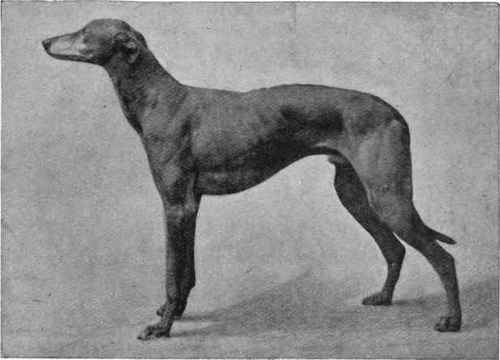
Fig. 32. - Greyhound Maney Starlight.
Continue to:


My Books

