


The Foxhound
Description
This section is from the book "The Dogs Of The British Islands", by J. H. Walsh. Also available from Amazon: The Dogs Of The British Islands.
The Foxhound
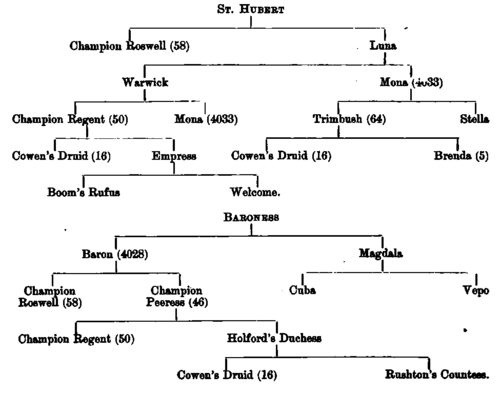
No dog has for so long a time been carefully bred, reared, and trained in large numbers as the English foxhound. Up to the time of the passing of the present Game Laws, the public greyhound was confined to a very few kennels, and in them only were pedigrees preserved with anything like care; but in many foxhound kennels careful records have been kept of the breeding of every litter for, at least, 150 years; and, I believe, there is no instance in which a cross of any kind has been tried - masters being content with improving the breed by selection of the best within its limits, taking care to go out of their several kennels for sires to prevent the close in-breeding which would otherwise inevitably lead to a delicacy of constitution inconsistent with the severe work demanded from the foxhound. When it is remembered that this hound is often kept moving for eleven or twelve hours without food, and after a fast from the previous noon, and that during the greater part of that time he is either forcing his way through thick covert in "drawing," or running at his best pace in pursuit of his game, the amount of stamina required is at once apparent.
To be sure of obtaining this constitutional quality, it is necessary to attend carefully to pedigree; for, without it, a handsome and useful hound, as far as appearance goes, might often be preferred on account of his exterior to another of lesser pretensions to beauty, who might yet from his breeding prove to be far the better animal when both had been entered to their game. As in the case of the racehorse, with regard to the Darley Arabian, most of our best hounds now trace back to the Osbaldeston Furrier, Sir R. Sutton's Hercules, or the Belvoir Comus; but since their days masters of foxhounds in every hunting country have vied with each other in breeding, not only a single hound of that form and quality, but a whole pack so "suity," as to vie with them in all important points. Nose combined with speed and stoutness have always been considered as the essentials for the foxhound; but of late years, owing to the enormous "fields" which have attended our leading packs, and the forward riding displayed by them, another feature has been demanded, and the supply in the "grass countries" has been obtained in a remarkable manner. I allude to the gift peculiar to our best modern hounds, of getting through a crowd of horses when accidentally " slipped" by the pack.
This faculty is developed to a very wonderful extent in all the packs hunting "the shires," varying, of course, slightly in each; and it is no less remarkably absent in certain packs otherwise equal to the Quorn and its neighbours, or even superior to them. The peculiarity is well known to hunting men; but no little annoyance is felt by the members of the several hunts to which I allude when reference is made to individuals; and having great respect for the tender feelings of every master of foxhounds and his followers, I shall not venture to make any attempt to allude more particularly to this matter.
Lord Poltimobe's Foxhound "Lexicon".
The appearance of the modern foxhound is greatly altered by the universal practice of " rounding " the ears, which has existed during the whole of the present century, if not longer. That the custom is useful in preventing "canker," either from foul blood or mechanical injury, is clear enough, and I can see no possible objection to it except from Mr. Colam's point of view. "Idstone" dislikes it on the score that the full ear " is a natural protection to the eye in drawing a covert or thorny brake, and that it is given by Nature for that purpose;" but I confess I cannot understand how this can be the case unless the drawing is performed in a retrograde manner, as, even when at rest, the ear does not approach the eye; and in drawing a thorny brake, it must be pushed back some inches behind the organ which, he says, it covers. The sole use of an abnormally large ear, as far as I can see, is to aid the internal organ of hearing, and it is only found in hounds which depend on co-operation for success - that is to say, who hunt in packs.
In this kind of hunting, the ear is required to ascertain what is given out by the tongues of the leading hounds, so as to enable "the tail" to come up; but whether or no "rounding" diminishes the sensitiveness of the organ of hearing, I am by no means prepared to say. It is, however, admitted by physiologists that the external ear aids the sense of hearing, and as this large folding ear is confined to hounds hunting in packs, which, as above remarked, depend on hearing for co-operation, it is reasonable to suppose that the hound's large ear is given him to aid in this kind of hunting; and, if so, it is by no means clear that rounding is an unmixed good, but that it has not the disadvantages attributed to it by "Idstone," is as clear to me as noonday.
Another mental peculiarity of the foxhound is his superior "dash" and tendency to cast forward rather than backward, for the bloodhound, otter hound, and old-fashioned heavy harrier still have a tendency to dwell on a scent, and sitting on their haunches mark their enjoyment-of it by throwing their tongues heavily and with a prolonged series of notes, during which their game is getting away from them. Such a deed would sentence any foxhound to the halter if seen by his master, and undoubtedly it is by selection, or possibly by crossing with the greyhound, that the change has been effected. However produced, there is no doubt that it exists, and that the foxhound is distinguished by it from all other varieties of his class.
The points of the foxhound are as follows:
Points Op The Foxhound
value. | |
Head......... | 15 |
Neck.......... | 5 |
Shoulders........ | 10 |
Chest and back ribs........ | 10 |
40 |
value | |
Back and loin...... | 10 |
Hind quarters....... | 10 |
Elbows......... | 5 |
Legs and feet........ | 20 |
45 |
value | |
Colour and coat......... | 5 |
Stern......... | 5 |
Symmetry.......... | 5 |
15 |
Grand Total 100.
1. The Head (Value 15)
1. The head (value 15) should be of full size, but by no means heavy. Brow pronounced but not high or sharp. There must be good length and breadth, sufficient to give in the dog hound a girth in front of the ears of fully 16in. The nose should be long (4 1/2in.) and wide with open nostrils. Ears set on low and lying close to the cheek.
The North Warwickshire Foxhound "Rosy.
2. The Neck (Value 5)
2. The neck (value 5) must be long and clean, without the slightest throatiness. It should taper nicely from the shoulders to the head, and the upper outline should be slightly convex.
3. The Shoulders (Value 10)
3. The shoulders (value 10) should be long and well clothed with muscle without being heavy, especially at the points. They must be well sloped, and the true arm between the front and the elbow must be long and muscular, but free from fat or lumber.
4. Chest And Back Ribs (Value 10)
The chest should girth over 30in. in a 24in. hound, and the back ribs must be very deep.
5. The Back And Loin (Value 10)
5. The back and loin (value 10) must both be very muscular, running into each other without any contraction or "nipping" between them. The couples must be wide even to raggedness, and there should be the very slightest arch in the loin, so as to be scarcely perceptible.
6. The Hind Quarters (Value 10)
6. The hind quarters (value 10) or propellers are required to be very strong, and as endurance is of even more consequence than speed, straight stifles are preferred to those much bent, as in the greyhound.
7. Elbows (Value 5)
7. Elbows (value 5) set quite straight, and neither turned in nor out, are a sine qua non. They must be well let down by means of the long true arm above mentioned.
8. Legs And Feet (Value 20)
Every master of foxhounds insists on legs as straight as a post, and as strong; size of bone at the ankle being specially regarded as all important. The desire for straightness is, I think, carried to excess, as the very straight leg soon knuckles over, and this defect may almost always be seen more or less in old stallion hounds. The bone cannot, in my opinion, be too large, but I prefer a slight angle at the knee to a perfectly straight line. With the exception, however, of Mr. Anstruther Thompson I never yet met with a master of foxhounds who would hear of such an heretical opinion without scorn. The feet in all cases should be round and cat like, with well developed knuckles, and strong horn, which last is of the utmost importance.
9. The Colour And Coat (Value 5)
9. The colour and coat (value 5) are not regarded as very important, so long as the former is a "hound colour," and the latter is short, dense, hard, and glossy. Hound colours are black tan and white - black and white, and the various "pies" compounded of white and the colour of the hare and badger, or yellow, or tan. In some old strains the blue mottle of the southern hound is still preserved, but it is generally voted "slow".
10. The Stern (Value 5)
10. The stern (value 5) is gently arched, carried gaily over the back, and slightly fringed with hair below. The end should taper to a point.
11. The Symmetry (Value 5)
11. The symmetry (value 5) of the foxhound is considerable, and what is called "quality " is highly regarded by all good judges.
Lord Poltimore's Lexicon, and the North Warwickshire Rosy may still serve to illustrate the foxhound as well as any modern specimen.
Continue to:


My Books

