


Chapter III. The Irish Wolfhound
Description
This section is from the book "British Dogs: Their Varieties, History, Characteristics, Breeding, Management, And Exhibition", by Hugh Dalziel. Also available from Amazon: British Dogs.
Chapter III. The Irish Wolfhound
To do full justice to this subject is almost impossible, owing to the fact that there has been a generally received impression amongst modern writers that this noble breed of dog is entirely extinct! That the breed in its "original integrity" has apparently disappeared cannot be disputed, yet there can be little doubt that so much of the true breed is forthcoming, both in the race still known in Ireland as the "Irish wolfhound " (to be met with, however, in one or two places only), and in our modern deerhound, as to allow of the complete recovery of the breed in its pristine grandeur, with proper management, in judicious hands. It is a fact well known to all modern mastiff breeders who have thoroughly studied the history of their breed that, until within the last thirty or forty years, mastiffs, as a pure race, had almost become extinct. Active measures were taken by various spirited individuals, which resulted in the complete recovery of the breed, in a form at least equal, if not superior, to what it was of yore.
Why should not, then, such measures be taken to recover the more ancient, and certainly equally noble, race of Irish wolfhounds ? It may be argued that, the services of such a dog no longer being required for sport, his existence is no longer to be desired; but such an argument is not worthy of consideration for a moment, for how many thousands of dogs are bred for which no work is provided, nor is any expected of them, added to which, the breed would be admirably suited to the requirements of our colonies. One after another the various breeds of dogs which had of late years more or less degenerated, as, for instance, mastiffs, fox terriers, pugs, St. Bernards, colleys, have become "the rage," and, in consequence, a vast improvement is observable in the numerous specimens shown from time to time. Let us, then, hope that steps may be taken to restore to us such a magnificent animal as the Irish wolfhound.
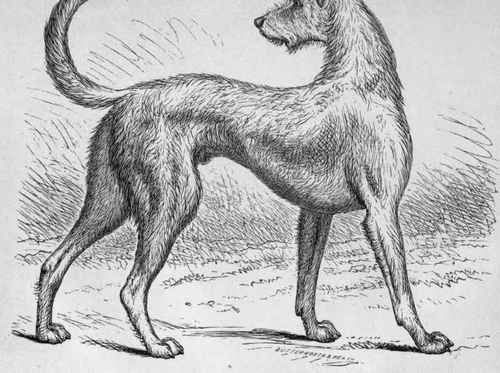
IRISH WOLFHOUND. (From an old dra y Renaigle.)
That we have in the deerhound the modern' representative of the old Irish dog is patent; of less stature, less robust, and of slimmer form, the main characteristics of the original breed remain, and in very exceptional instances specimens "crop up " that throw back to and resemble in a marked manner the old stock from which they have sprung; for instance, the dog well known at all the leading shows (now for some years lost to sight) as champion Torunn, beyond the facts that he required a somewhat lighter ear and still more massive proportions, combined with greater stature, he evidently approximated more nearly to his distant ancestors than to his immediate ones. The matter of ear here alluded to is probably only a requirement called for by modern and more refined tastes, as it is hardly likely that any very high standard as to quality or looks was ever aimed at or reached by our remote ancestors in any breed of dogs. Strength, stature, and fleetness were the points most carefully cultivated - at any rate, as regards those used in the pursuit and capture of large and fierce game.
It is somewhat remarkable that, whilst we have accounts of almost all the noticeable breeds, including the Irish wolfhound, there is no allusion to any such dog as the deerhound, save in writings of a comparatively recent date.
The article or essay on the Irish wolfhound, written by Richardson in 1842, is, it is supposed, the only one on this subject in existence; and whilst it is evident to the reader that the subject has been most ably treated and thoroughly sifted by him, yet some of his conclusions, if not erroneous, are at least open to question. It is a matter of history that this dog is of very ancient origin, and was well known to and highly prized by the Romans, who frequently used him for their combats in the arena; and that he was retained in a certain degree of purity to within a comparatively recent period, when, owing to the extinction of wolves, and presumably to the indifference and carelessness of owners, this most superb and valuable breed of dog was unaccountably suffered to fall into a very neglected and degenerate state.
From the general tenor of the accounts we heard of this dog's dimensions and appearance, it is to be gathered that he was of considerably greater stature than any known race of dogs existing at present, and apparently more than equal to the destruction of a wolf.
It is an incontestable fact that the domestic dog, when used for the pursuit of ferocious animals, should be invariably larger, and apparently more powerful, than his quarry, as the fierce nature, roving habits, and food of the wild animal render him usually more than a match for his domesticated enemy, if only of equal size and stature. We know that the Russian wolfhounds, though equal in stature to the wolf, will not attack him single-handed; and wisely, for they would certainly be worsted in the combat.
The Irish wolfhound, being used for both the capture and despatch of the wolf, it would necessarily have been of greyhound conformation, besides being of enormous power. When caught, a heavy dog such as a mastiff would be equal to the destruction of the wolf, but to obtain a dog with greyhound speed and the strength of the mastiff, it would stand to reason that his stature should considerably exceed that of the mastiff - one of our tallest as well as most powerful breeds. The usual height of the mastiff does not exceed 30in.; and, arguing as above, we may reasonably conclude that, to obtain the requisite combination of speed and power, a height of at least 33in. would have been reached. Many writers, however, put his stature down as far exceeding that. Goldsmith states he stood 4ft.; Buffon states one sitting measured 5ft. in height; Bewick, that the Irish wolfhound was about 3ft. in height; Richardson, arguing from the measurements of the skulls of the Irish wolfhound preserved at the present time in the Royal Irish Academy, pronounced it his opinion that they must have stood 40in,
Continue to:


My Books

