


Chapter XVII. The English Setter
Description
This section is from the book "British Dogs: Their Varieties, History, Characteristics, Breeding, Management, And Exhibition", by Hugh Dalziel. Also available from Amazon: British Dogs.
Chapter XVII. The English Setter
Difficult as it admittedly is to trace the history of any of our modern breeds of dogs, although, in most instances, their manufacture, if I may use the term, into their present form is of comparatively recent date there is, in respect to the setter, a general agreement among writers and breeders that our present dog is largely derived from the spaniel; indeed, the proofs of this are very conclusive - the family likeness is in many respects yet strongly preserved, and in some kennels, where they have kept pretty much to their own blood, following different lines from our show and field trial breeders, this is most markedly so. No more pronounced instance of this has come under my notice for years than a number of dogs, all of the same blood, shown by the Earl of Carlisle and other gentlemen at the Border Counties Show at Carlisle in January, 1877. These were mostly liver and white in colour, stood higher than the show-bench spaniel, shorter and rounder in the head than the present day setter, but strong useful looking dogs, showing a lot of spaniel character in general formation, carriage of ears, and coat and feathering, the coat having a strong tendency to curl, and some of them showing as distinct a topknot as the Irish water spaniel, although not so large.
The writer on setters in the "Sportsman's Cabinet," 1802, tells us that in his day, in the northern counties, the pointer was called the smooth spaniel, the setter the rough spaniel; and, although he speaks of this localism with surprise as a misnomer, it was really the preservation of an old distinction, the setters, or setting spaniels, being so named to divide them from their congeners, used for different work, and named cockers and springers. Our forefathers do not appear to have been so fastidious respecting the appearance of their dogs as we are, but undoubtedly the spaniel was preeminently their setting dog, both for use with the net and the gun.
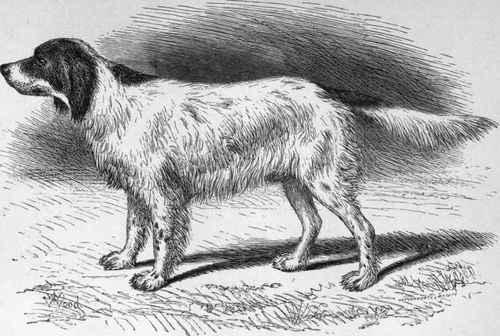
MR. WARDLAW REID'S LAVERACK SETTER "SAM." Sire Dash II. (K.C.S.B. 1341) - Dam Moll III, by Fred I out of Belle II
In a much older book than the "Sportsman's Cabinet," the "Gentleman's Recreation," the writer gives the following directions how to select a setting dog: "The dog which you elect for setting must have a perfect and good scent, and be naturally addicted to the hunting of feathers, and this dog may be either land spaniel, water spaniel, or mongrel of them both, either the shallow-Sewed hound, tumbler, lurcher, or small bastard mastiff. But there is none better than the land spaniel, being of a good and nimble size, rather small than gross, and of a courageous mettle, which, though you cannot discern being young, yet you may very well know from a right breed which have been known to be strong, lusty, and nimble rangers, of active feet, wanton tails, and busy nostrils, whose tail was without weariness, their search without change-ableness, and whom no delight did transport beyond fear and obedience."
Many other writers might be quoted to the same effect, and it is quite clear that the old setter was simply a spaniel kept to certain work, and as useful to the old sportsman who netted his covey of partridge as his modern representative is to the present "shooter on the wing," who is content to bag his brace by a right and left from his patent breechloader. Somerville, that thorough sportsman and true poet, gives a lucid and very happy description of the working of the setter in the following lines:
When autumn smiles, all beauteous in decay,
And paints each chequered grove with various hues,
My setter ranges in the new shorn fields,
His nose in air erect; from ridge to ridge,
Panting, he bounds, his quartered ground divides
In equal intervals, nor careless leaves .
One inch untried. At length the tainted gale
His nostrils wide inhale, quick joy elates
His beating heart, which, awed by discipline
Severe, he dares not own, but cautious creeps
Low-cowering, step by step; at last attains
His proper distance, there he stops at once,
And points with his instructive nose upon
The trembling prey. On wings of wind upborne
The floating net unfolded flies; then drops,
And the poor fluttering captives rise in vain.
These were the halcyon days of sport when driving, battues, and mowing machines were alike unknown, and, rude as the appliances for taking game were, they gave full play to the capabilities of a good setter, the clever working of which gave such genuine pleasure to the sportsman.
Whether the modern setter has been produced from the spaniel by careful selection, or by a cross with the pointer or some other breed, it is difficult to decide; many have supposed the flat coat has been obtained by a cross, but selection would quite account for that, as well as the change in formation.
Since the institution of dog shows and field trials a considerable impetus has been given to dog breeding, and in the strife for fame none has been so successful as the Laveracks, which, for elegance of outline, are unsurpassed by any breed of dogs. These, and crosses from them, are now pretty well spread over the country, and are also very fashionable in America. Sam, late the property of Mr. W. Wardlaw Reid, and the subject of our engraving, was a pure Laverack, brother to Mr. Purcell Llewellyn's Countess and Nellie, by Dash II. out of Moll III., and so going back to Ponto and Old Moll. Sam was a dog showing great quality, and with a good frame, free from the extreme delicacy of appearance which not a few modern setters have; and I am of opinion size and stoutness are sometimes a little too much sacrificed to elegance.
Mr. Purcell Llewellyn now claims to have produced a distinct strain of his own; he has been unquestionably a large and successful breeder of both good and handsome dogs, and his breed is now well known in the United States of America, to which a great number of them have been shipped as the "Llewellyn setter." The strain is founded on Laverack blood, and has on more than one occasion given rise to discussions which it would be unprofitable for us to enter upon here.
Continue to:


My Books

