


The Pointer. Part 5
Description
This section is from the book "British Dogs: Their Varieties, History, Characteristics, Breeding, Management, And Exhibition", by Hugh Dalziel. Also available from Amazon: British Dogs.
The Pointer. Part 5
Many otherwise good dogs turn out useless because of their defective temper, and, therefore, I think it is an all-important matter to get a good-tempered dog, especially if he is to be trained for sporting purposes, for in his work he has so continually to hold in check his natural instincts that, unless he has a good temper, he is continually forgetting his previous training. As for myself, I have quite decided never again to undertake to train a dog that is thoroughly self-willed. It is, at best, a tiresome undertaking, and, as yet, I have never found it worth the trouble it entails. When a dog of this temperament gets beyond your immediate control, he is often getting into trouble by doing something that is sufficient to annoy you, or else the close attention necessary in working him destroys half the pleasure the sport should afford; at least, such is my experience. Dogs with a jealous disposition are, I consider, very defective. They are difficult to deal with when using in braces, because they are not to be depended upon as "backers," and, when opportunity serves them, they will take away the other dog's point - a most serious fault.
This same failing makes them reckless in their range, and they have the stupid habit of follow the leader, instead of taking up an independent beat, and, often from sheer jealousy, commit faults (amongst others, that of "flushing"), not from want of nose, but from giving too much attention to what the other dog is doing, instead of minding their own work. What is most needed in a pointer to make him a good workman is a good nose, plenty of pace, a level sweeping stride, that will enable him to hunt a lot of ground without distressing himself, a natural love of hunting, making him anxious to find game, with sufficient perseverance to make him continue ranging, even where game is scarce; a lively, kindly, temperament, with plenty of courage without being headstrong, not jealous of a companion, though ever ready to do his share of work, standing correction for a fault without getting sulky or refusing to work, neither sly, shy, nor wilful; carrying his head well up, never stooping to ground scent; having sufficient brains to make him clever at getting on to "point" by making the best use of the wind in quartering the ground.
When a sportsman has succeeded in breeding or obtaining pointers possessed of the qualities I have enumerated, as necessary for success on the show-bench and in the field, if he takes my advice, he will be very chary in parting with them.
The gentlemen that at present possess dogs nearest to my idea of the model pointer are - Messrs. J. H.Whitehouse, Samuel Price, G. Pilkington, E. Lloyd Price, G. Moore, T. Statter, C. H. Mason, Heywood-Lonsdale, W. Arkwright, Barclay Field, R. P. Leeche, Viscount Downe, and Lord Sefton.
The brace illustrated, Special and Stella, combine in a marked degree those qualities I have attempted to describe, and which I consider are sine qua non in a first-class pointer. Stella has been decided by competent judges to be one of the best large pointer bitches in England, as evidenced by the fact that some five years ago she won the cup at the Crystal Palace, and then, after a rest of four years, was again shown and won first Palace, first Birmingham, and then took champion cup at Birmingham in 1878, which proves that for the last few years nothing has been produced that can relegate her to a "back seat." She is one of the very few Sancho bitches still living, and it is to this blood much of the excellence of the pointers of 1879 is due. I may just mention the fact that very prominent - indeed, the most prominent - prize winners for years past have been direct descendants of Sancho, viz., champions Wagg, Don II., Pearl, Blanche, Macgregor, Cedric, Luna, Stella, etc, etc. What other dog can show such an illustrious family? And it must be remembered that this dog died very young. His litter brother, Chang, too, was a champion in his day.
Now, leaving the past, we then find that so strong is his blood that his daughter, Mr. Leeche's Belle, when put to Mr. Samuel Price's Bang, has in two litters produced a whole string of winners, sufficient to sweep the board for some time to come. One of the first litter, Bow Bells, has scarcely suffered a defeat. She has in three years taken the first prizes and champion at the leading Kennel Club shows. £200 has been offered for her. Her sister, Zeal, has also been successful here, and more so in America. If only shown in good condition she is almost beyond beating in any company. Again we find, in a strong class at the late Alexandra Palace Show, five bitches out of a later litter, sisters to Bow Bells and Zeal, are those left in for all the prizes given in this class, one of them afterwards taking the cup given by The Country as the best sporting puppy bred in 1878. These contain a large amount of Sancho blood, as their dam was by Sancho, and their sire, Mr. S. Price's Bang, was by Brockton's Bounce, the sire of Sancho. This is in-breeding, and probably accounts for the smallness of the pointers produced by the Belle and Bang cross. However, this is sufficient to establish beyond doubt the Sancho blood as of the very best.
Besides these being good, show-bench dogs, they are equally good in the field; indeed, Rapid, Romp, Macgregor, Bow Bells, Zeal, and Wagg have all figured in field trial prize lists, so their achievements must be added to the successes of the same blood. It is a rare thing to find pointers of this strain that are not good at work, providing, of course, they have been properly handled. They are rather excitable, but when settled down to their work they are very reliable, and no day is too long and no work too hard for them.
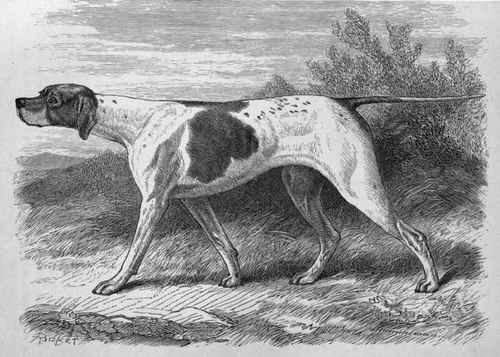
MR. G. THORPE BARTRAM'S POINTER BITCH "STELLA." Sire Sancho (K.C.S.B. 1004) - Dam Bess, by Hamlet.
Continue to:


My Books

