


Hints On Shooting And Hunting Game
Description
This section is from the book "How To Train Dogs And Cats", by Frederick H. Erb, Jr. Also available from Amazon: How To Train Dogs And Cats.
Hints On Shooting And Hunting Game
I find many ups and downs in different dogs of different breeds. Some people will say they have the only breed of dogs. Now, what standpoint they get that from I would like to know. My life's experience has been that about two dogs out of ten show good nose scent, so you see that a person's chances are not the best to get a sure one, or a high class field dog, at all times. But you can reverse things by proper training and make fair field dogs out of them by breaking them to retrieve first, and teaching them to always stand their dead bird first before retrieving it. This will get them interested in their nose work and will give them a good start to use their noses on live birds in the field and will make fair shooting dogs out of them. I always like to start on a dog at six months old, as he is then at the height of his ambition, and can be taught to do anything a great deal easier than when older, and nine times out of ten he will be ready to handle the coveys or flocks of birds he may come in contact with. The best dogs I have ever seen were brought up at that age. Ninety-nine men out of one hundred that own dogs do nothing but feed them well and keep them in a cellar or a closed yard for a year, then ask some handler to train their dogs. Off the dog goes, scared to death the minute he is put in the box for shipment until the handler gets him. Now, what does the handler do? The only thing for him to do is to pet and try to make friends with him. No success; let him loose and he runs off, and you can't help but say the handler is up against a hard proposition. But, if the owner would get off his pup at six months to the handler, or take the pup out walking so he would get used to seeing things, it would take all the cowardice out of him. Look at horses at one and two years old making world records! They are not shut up in a box-stall and not let out, but are given plenty of good exercise and are petted, and this is the way dogs ought to be treated.
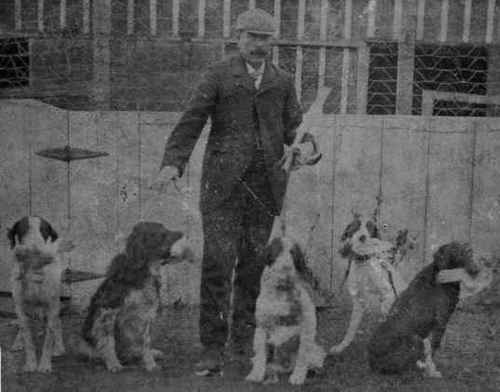
When taking a young dog into the field let him go and do as he pleases for the first few times. This will encourage him to hunt and not be afraid of you, and get an idea of what you want him to do. Then, when you want him to settle down for work, so you won't have to whip him, or take any of his high ambition out of him, let him drag a chain, say about three feet long, and if he don't cut his ground up to suit you, hang two chains on him. Now, don't try to do this in one day, but take from ten days to two weeks; then put him on birds. You will see he will make points and hold his birds and will not jump in, as he will be afraid the chains will lick him. Don't get excited yourself, but let the dog get excited and anxious and you watch him. Some of the best dogs that ever lived will make many mistakes during the day, and the mistakes your dog makes will be easy to overcome by your watching him. Read this book over carefully and pick out the best points that will help you work your dog. I have worked over three thousand dogs and traveled many miles over the country to show how dogs worked that I broke by the rules of this book.
If you have a wild dog, hang a chain on him. Get a window weight about a foot long and snap a four foot chain in the hole in the weight, having the chain just long enough to lie on the ground at the dog's front feet, so that there will be no danger of his getting fast in anything. A week or ten days of this will make a different dog out of him. Keep the chain and weight on him until he minds you, but as soon as he minds, take the weight off and let him drag the chain, and when he understands, he will stop running away or chasing chickens, and will be obedient to the voice or whistle. At first, when the chain is finally taken off, he will not go out far, but encourage him a little and he will soon begin to cut up his ground right and left, and if at the same time you train him to mind your whistle, or the movements of your hand to right or left, you will find that you will not have to call him or frighten the farmers or the game by loud noises.
Ninety-nine men out of one hundred want a dog that don't get away from them more than fifty to one hundred yards.
To have success in hunting you must keep your dog under control. If you have a dog that ranges wide and fast do not lose your head and get excited, as most hunters are apt to. If your dog is fast don't hunt fast, but every little while stop and let your dog locate you; but with the slow dog, follow him. If you want to go to the left or right, whistle, and the dog will look up and he will see you move your hand, which is a signal to go to the left or right. If you have a fast dog, hang a couple of chains on him and let him drag them for a while till he gets to understand your signals, and when you have him under good command, take your chains off of him and you will be able to work the fast dog just as well as the slow dog. The chains will break nine out of ten dogs of this bad fault, and also teach a dog to quarter his ground up nicely. He will also pay all attention to you when you speak to him or blow the whistle, as he is on his guard, thinking if he don't mind you that you will put the chains on him again. No matter how tired he is, if he don't mind you, hang a chain on him until he does mind you. You will see some dogs coax and come in and stay around you and bark for you to take the chains off, so they can go out and do as they please, but don't pay any attention, go right along and the dog will go out and hunt when he sees you will not take the chain off. If your dog is broken by my system to make a perfect retriever out of him before you go into the field, you will not have any trouble.
Teach your dog to have confidence in himself. I always teach a dog to retrieve first and to be obedient. I always say "Hold," and then "Go fetch dead." When he comes in with what he was sent after I say "Hold," raising my hand and then taking it from his mouth. Always stand still and let your dog do the hunting, and retrieve the dead bird or bundle right up to you. Then, after I have him a nice retriever, I put him at the words "Charge" or "Drop." That means "Lie down." After you get him to charge nicely, then have him charge and stay there and you move back a few feet at a time; then say, "Come boy," moving the hand at the same time; moving the hand comes handy when your dog is a long way off, and you want him to go to the left or right. Always blow your whistle also when you desire your dog to go to the left or right; when you want your dog to come in from the field, blow your whistle two or three times in succession. Now, you have him under good control and ready to go in the field.
Continue to:


My Books

