


Taking A Gun Apart
Description
This section is from the book "How To Train Dogs And Cats", by Frederick H. Erb, Jr. Also available from Amazon: How To Train Dogs And Cats.
Taking A Gun Apart
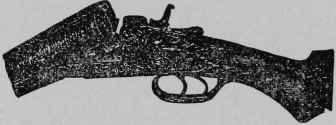
Have your dealer show you how to take your gun apart and put it together; how to let the hammers down and how to cock it. I have been out hunting with many an amateur who did not know how to put his own gun together.
Learn how to clean and oil your gun and always carry some good gun oil and a gun rod with you when going hunting.
Always be careful of and with your gun. Do not go around a field with a loaded gun. Never get over a fence with the loads in your gun, nor carry it across your arm when doing so. When in the field or in company, keep your gun pointed well up to the sky while walking.
To have success in the field with game, take plenty of time and move your gun along with the bird and pull as you move. Don't stop the gun or you will miss, as the bird keeps moving and so must you.
Don't get in a hurry while shooting such birds as quail, snipe, woodcock and young chickens, as nine out of ten are killed under twenty yards. Keep a level head, use common sense and move the gun, then with a good retriever you will be sure of a fine day's sport.
If you shoot right handed, extend the left hand well forward on the gun barrel; in case you are left handed, reverse, but in either case, grip the gun tightly with your hand, so that it will not move easily.
To be a good shot, always follow what you shoot, be it to the right or left, up or down. If you are not careful you will stop your gun unconsciously, and then wonder why you did not kill your bird, while the very fact that you did not kill it is proof that you stopped your gun. Move your gun with the bird and you will make a dead shot every time.
For a bird flying straight away, cover full.
For birds of any kind that rise as they fly, raise at the same time you pull.
For birds flying low, follow low, and keep the gun moving as you pull.
In all these cases hold the gun about six inches ahead of the bird and pull while moving the gun, so that the bird will fly into your load.
In shooting, while sitting, always hold low on the bird, say a foot and a half. Many may think that this is holding too low on a bird, but the success of the shot is proof of its value.
For a person who has had no experience, it will save time and money to get a target trap to practice with before wasting powder in the field. Set it firmly and stand close to it to begin with, moving back gradually as you become able to hit the targets. Keep your gun moving with the target, and aim low, as the gun will lift at the moment of shooting. Twenty years ago the trap shooter held his gun below the elbow until the bird was on the wing. Some wonderful scores were made at this style of shooting.
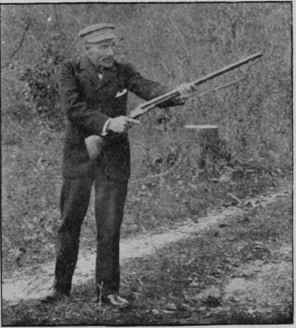
STYLE OF HOLDING GUN TWENTY YEARS AGO.

STYLE OF HOLDING GUN AT PRESENT TIME.
At the present day he holds his gun to his shoulder, ready for the "bird" to be thrown from the trap.
If you have no knowledge at all of firearms, begin your practice with a rifle, size .22, which will be cheaper and easier to learn with. If you are near the water, take a board two feet long and six inches wide, and put a tin can in the center of it. Tie a rope thirty or forty feet long to the board and float the board on the water. Have some one draw it along the surface slowly while you stand some twenty or thirty feet away, and try to follow the object with your gun. When you think you can follow, shoot at the can; even if you miss, the water will tell you just where you shot, and so you can make your allowance and see how fast you will have to move your gun to hit the can.
When you can hit every time, have a can tossed up in the air six or eight feet at first and try to hit it. Have the can thrown up easily and steadily and not by jerks, and aim low, but keep the gun moving.
If you are not near any water, tie a can to a long string and have it pulled along the ground, slowly at first, then faster and faster as you improve. Shoot at it sidewise, crosswise and every way you can think of to give you practice and accustom you to all kinds of shooting.
If you have little time for field work or are so situated that you have no opportunity to practice out of doors, try shooting on roller skates. This will try your nerve and teach you to have self-possession and poise. If you have a long hall in your house or a good cellar, you can have all the practice you want at very little trouble or expense.

SHOOTING OFF ROLLER SKATES.

SHOOTING WHILE SEATED.
By using a .22 rifle, with shot shells, you can practice anywhere in the house with perfect safety to the walls. The shell is cheap and scatters so much that it does no damage.
By hanging a piece of heavy canvas, ten feet square, from a couple of screw eyes in the ceiling, two or three feet from the wall, so that the canvas will not swing back and hit the wall and letting it swing freely from the bottom, you can shoot thousands of shot cartridges at it and not pierce it. The shot will roll off the loose canvas and fall harmlessly on the floor.

TEACHING A BOY TO SHOOT.
Pin small paper targets on the canvas and you will have as fine a target as you want. But be careful not to hang the canvas near a door or window, unless it is kept locked from your side, and so avoid accidents.
Stand fifteen or twenty feet away from the target, increasing the distance as much as possible as you grow proficient. When you can hit the bits of paper, hang a small can, a rubber ball, bits of coal, anything that can be hit, on a string, and let this swing from another screw eye in the ceiling, about three feet in front of the loose canvas. Now, you have a fine swinging target and one hard to hit.
Practice all kinds of fancy shots, over the head, crosswise, back to object with gun on shoulder and using a mirror, while skating back and forth, and many others.
If children were trained from an early age to handle and care for firearms, there would be fewer accidents. It is ignorance and the novelty of it that makes people look in a gun "to see if it is loaded." If they were used to handling one they would never do such a senseless thing.
Begin to teach a child when he is seven years old. Give him a small air gun and show him how to hold and sight it and impress upon him that he cannot have it if he is at all careless with it. Never let him practice alone until he is old enough to have good judgment and discretion. Never let him play with it. Teach him that it is not a plaything, but a weapon to be proud of if he can handle it well.
Teach him to stand straight and shoot with both eyes open, from the first. Make him care for his own gun and keep it clean and well oiled.
It is well to have the gun a little heavy at the start so that it will not kick and frighten him, as nothing spoils one's shooting like nervousness.
Never leave the load in the gun, and never, never let it be pointed at any one.
Give the child a simple target to begin with and let him stand not more than ten feet away so that he will hit it frequently; this wili encourage him to try and hit every time.

A SEVEN-YEAR-OLD HUNTER.
As he advances in his work, give him swinging objects to practice on, cans tied on the end of a long fish pole and swung gently back and forth, bits of coal thrown in the air, and on a straight line about ten feet above the ground. This will give him fine practice for field shooting.
Continue to:


My Books

