


Teaching A Dog To Point
Description
This section is from the book "How To Train Dogs And Cats", by Frederick H. Erb, Jr. Also available from Amazon: How To Train Dogs And Cats.
Teaching A Dog To Point
It is not an easy thing to teach a dog to point. In the first place, a great many dogs have not a good nose scent, and many times there is no chance to find game to work the dogs on.
I have found it easy to make a dog point no matter how young he was, by breaking him to retrieve first; then when sending him after the dead bird, I would call "Hold," just as soon as I saw him making scent on the bird, and it always won a point.

TEACHING A DOG TO POINT.
When I first take a dog to the field and find a flock of birds, I do not shoot at them. In this way I get the dog interested and he will begin to point right and left. Then I walk up to the dog and say, "Hold," and pet him, and from that time on I will have no more trouble.
If a dog offers to stand tame chickens on the road or in the yard, encourage him by petting him. It will soon teach him that you expect him to stand or point. Of course, a great many think that standing by sight hurts a dog's field work. It does not hurt him at all. This shows the good qualities of the dog and that he has lots of game sense. When he scents the birds in the field he will be that much steadier and make a nicer point than a green dog that knows nothing about pointing. Always try to get a dead bird of some sort to work your dog on. By breaking a dog to retrieve, by my system, he will always point his dead bird before he retrieves it.
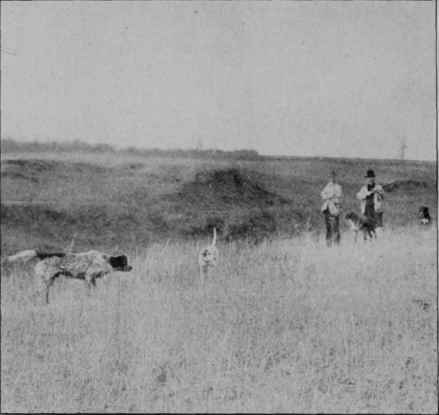
TEACHING A DOG TO POINT.
When you start your dog on point work be sure and go where you will find birds. Don't get excited when he points or flushes, but just blow the whistle, which means to wait until you come to him; keep cool and talk to him, saying "Steady" and "Hold." Have a whistle in your pocket at all times and blow it often, that the dog may get used to it and understand why you blow it and what it means. If your dog is fresh and unused to exercise, and is off like a shot as soon as freed, hang a chain on him and he will soon settle down and behave himself. Use the following words in the field: "Go hunt dead," "Go hunt him up," "Move to the right," or left, "Charge," or lie down, "Come heel," walk close to you, "Heel to the wagon," "Jump in the wagon," by name, and out the same way. Commence on a dog while young to work him in the field, or anywhere else, and the less words and noise you make in breaking him the better for both you and him.
Continue to:


My Books

