


Historical Sketch
Description
This section is from the book "The Book Of Dogs - An Intimate Study Of Mankind's Best Friend", by Ernest Harold Baynes, Louis Agassiz Fuertes . Also available from Amazon: The Book of Dogs: An Intimate Study of Mankind's Best Friend.
Historical Sketch
As we have noted, there is good evidence that men and dogs were associated in very remote times. Among the remains left by the ancient cave-dwellers, half-petrified bones, some human, some canine, are found lying together. Remnants of dog bones have been found in the Danish "kitchen-middens" - heaps of household rubbish piled by the people of the newer Stone Age - and dog bones of later periods have also been found in Denmark.
Of course, it is often impossible to form any idea of the appearance of these dogs in life; but in Switzerland there have been found records which show that a large dog differing widely from the wolf and the jackal, and which is said to have borne a resemblance to our hounds and setters, was at least partially domesticated by the lake-dwellers.
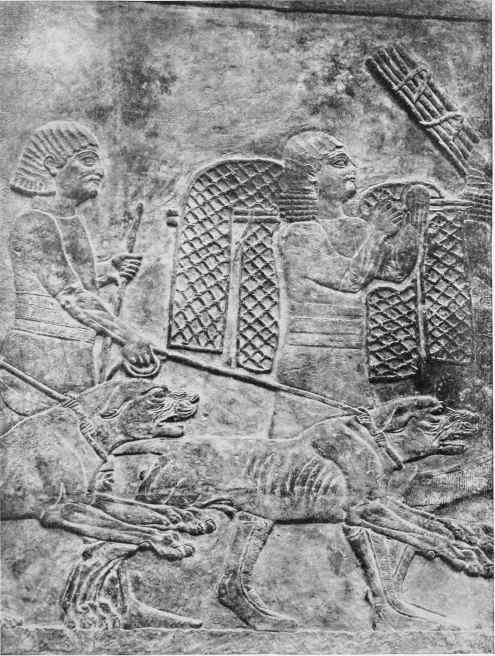
Dogs Of The Chase 2,500 Years Ago.
That the men of the so-called Reindeer period had dogs which they used in the chase, and perhaps for other purposes, is evidenced by the crude pictures which they cut in the rocks to record their mighty deeds and adventures.
One such picture, 5 feet high by 12 feet long, cut thousands of years ago in the solid quartz at Bohuslau, on the shores of the Cattegat, depicts what seems to be a hunting party consisting of men, dogs, and horses, just landed from a boat and engaged in the pursuit of reindeer.
Other prehistoric artists have engraved rude figures of dogs on the surface of bones and horns; and these, no doubt, were aboriginal dogs. In fact, with the exception of a few islands, namely, the West Indies, Madagascar, some of the islands of the Malay Archipelago, New Zealand, and the Polynesian Islands, there are few parts of the world where we cannot find evidence that the dog in some form existed as an aboriginal animal.
Continue to:


My Books

