


Sheep-Killers - The Pariahs Of Dogkind
Description
This section is from the book "The Book Of Dogs - An Intimate Study Of Mankind's Best Friend", by Ernest Harold Baynes, Louis Agassiz Fuertes . Also available from Amazon: The Book of Dogs: An Intimate Study of Mankind's Best Friend.
Sheep-Killers - The Pariahs Of Dogkind
NOT the vivid oratory of a Vest, nor the lovable brush of a Land-seer, nor yet the blazing eloquence of a Byron has served to overdraw the picture of the well-bred, well-trained dog. But those friends of the dog who are most jealous of his good name are among the first to advocate legislation that will at once protect the public from the evil deeds of the pervert of his kind and the good dog from maledictions he does not deserve.
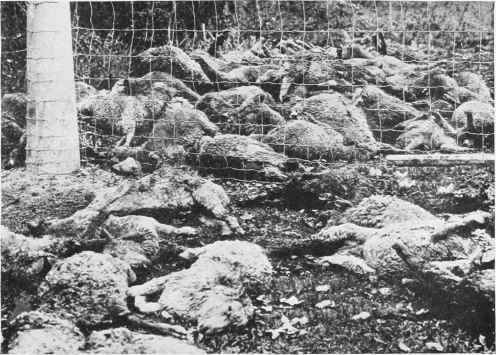
Remains Of 193 Sheep Killed In A Single Night By Two Dogs.
Photograph from Department of Agriculture.
In these days, when wool is so high that one has to wonder whether it was not the sheep instead of the cow that jumped over the moon; in these times, when a hungry world abroad and a diminishing meat area at home alike call loudly for new meat production, the nation suddenly awakes to the fact that the farm east of the Missouri River having a flock of sheep is the exception and not the rule. And why?
Not because sheep-raising is naturally unprofitable. Presenting her owner with a fine lamb or two every spring, giving him a nice fleece of wool at the beginning of each summer, and yielding a goodly lot of savory mutton at the end of her career, a good ewe is no mean investment, normally.
If the farmer has a field overrun with briars, a flock of sheep will do the work of two or three grubbing-hoes. They will live where cattle would starve, and thrive on grass too short for anything else except goose pasture. The farmer loves a flock of sheep about the place. Then why does he not have them?
The Farmer's Plaint
Here is his own answer:
"Only a few days ago the last of my sheep were driven away. I watched those old Merino ewes and their foldy-necked lambs walk down the road and out of sight, and, as I watched, a lump came into my throat and the tears were not far away.
"Now these ewes are gone. Because I have lost interest? Far from it! I would walk farther to see a good Merino than any other animal that lives. Because I think tariff changes have knocked the industry into a cocked hat? No. for I think the future of the industry is bright, and that the "golden hoof" will be worth as much - perhaps more - in the future as in the past. Then why? The one reason for present abandonment would be shouted by thousands of shepherds if the question were put - just dogs!
"Old stuff? Maybe to you, but it's ever new to the sheepmen of eastern Ohio, Pennsylvania, and West Virginia, and to flock owners everywhere. The man who has walked out to his pasture and found dead, torn, crippled, bleeding, scared sheep will appreciate what I say.
"My farm is bounded on two sides by small towns, with a joint dog population of two hundred; one mile away, on the third side, is still another village, and two miles in the remaining direction is a fourth - the last two with more dogs than people. We found our sheep dead: we found them with throats cut and legs torn off; we found them one time huddled together in the farthest corner of the field, another time scared into the public highway, and, again, chased four miles from home.
"The foreigners' dogs chased them; the neighbors' dogs chased them; dogs of all kinds, seen and unseen, had a whack at my Merinos.
" 'Why don't you shoot the marauders?' queries one. 'Why don't you poison them?' another asks. And 'Why don't you keep your sheep at the barn?' another wants to know.
"But can a farmer who gets up at half-past four in the morning, finishing his chores, eating his breakfast, and reaching the field by seven, sit up all night waiting for the dogs? Or do you expect him to violate the law that prohibits the setting of poison? Or should he, after having followed a plow from sun-up to sun-down, have to drive his sheep in every night and out every morning?"
Continue to:


My Books

