


Chapter IV. Dietary For Puppies
Description
This section is from the book "Kennel Secrets: How To Breed, Exhibit And Manage Dogs", by Ashmont. Also available from Amazon: Kennel Secrets: How to Breed, Exhibit and Manage Dogs.
Chapter IV. Dietary For Puppies
Having taken a general survey of the range of materials at the command of man for the purpose of feeding his dogs, it is well to return and, starting as it were with a litter of puppies about leaving their mother, apply the principles laid down in the foregoing chapters.
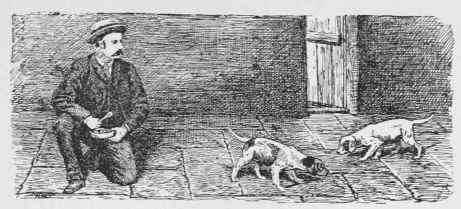
The period of weaning fixed by breeders is between the fourth and fifth weeks; and this seems in accord with the plans of Nature, for the milk secretion is then as a rule falling off, both in quality and quantity, and most mothers give their young other food if their caretakers fail to do so.
Closely observe the average mother that is denied assistance in nourishing her little ones after her milk has begun to fail and she will soon be detected in providing for them from her own feeding-pan, conveying the same in her stomach and regurgitating or vomiting it up before them. And when the puppies are so situated that several experienced mothers have access to them, if their own fails to do this the chances are many that some one of the others will assume the duty.
It can safely be accepted, therefore, that even where the milk supply seems abundant the weaning should be fairly begun during the fourth week. But it is never advisable to wait until this period is reached before taking the preparatory steps, for exigencies are very liable indeed to arise which make weaning imperative at once and complete.
Consequently in every instance puppies should be taught to eat at the earliest possible age, which is soon after the second week where those who assume the duty are patient and persevering. And such rarely find it difficult if they put a little milk into a small shallow dish and gently dip the tips of the puppies' noses into it for an instant, and then allow the little ones to draw back and lick off what adheres.
The milk used in these attempts should be scalded, diluted with an equal quantity of water, and about "blood-warm."
But it is not alone sufficient to teach puppies to drink milk, for they should be accustomed early to the taste of flesh; and the proper food to commence with is very thin broth made specially for them from beef or mutton.
Of course, only a little milk or broth should be allowed at first, - barely sufficient for the purpose for which they are used - but in all cases, whether or not the mother's milk appears sufficient, one of these foods can properly be given about twice daily in the third week, and in gradually increasing quantities up to the weaning.
To be more definite, at each attempt about a teaspoonful of milk or broth will be sufficient for educational purposes. Once eating well, a tablespoonful of one of these foods, if they care to take as much, may be allowed twice daily for three days; and thereafter about a tablespoonful more may be added to their allowance every second or third day until the weaning commences, assuming that the mother is ample support, but it goes without saying that where she fails the wants of the puppies are to be satisfied.
Gradual weaning, to cover about one week, should be the rule in all cases that will admit it - that is, in all cases in which the mothers are secreting fairly good quantities of milk. But the period can scarcely be prolonged beyond this with safety, for when a mother is nursed only once or twice in twenty-four hours her milk becomes altered and might prove injurious.
When it is decided to wean, the mother should be excluded from her puppies during certain hours each day and permitted to return at fixed intervals, between which and at fixed times they should be fed on cow's milk. As for instance, she should be let out about seven in the morning, admitted about noon and allowed to nurse them, then be excluded for another interval of about five hours, after which she should be permitted to return and care for them until the following morning. And during her absence they should be fed between nine and ten in the forenoon and about three in the afternoon.
Some breeders do not exclude the mother while the weaning is going on, but their course is open to the objection that too much or too little food is likely to be taken at times; moreover an admixture of cow's milk and mother's milk is not advisable when it can be prevented, for together they seem less well borne than when given separately.
Two full feedings of cow's milk each day are all that puppies should have during the first three days of the weaning, - provided always that number is quite sufficient with the quantity of milk afforded by the motherbut after that they can be fed three times a day. For instance, the mother being taken from them at about seven in the morning and kept away until night, they should be fed shortly after nine, at noon and about three. Then three hours later - about six - the mother should be admitted to them to remain until the following morning, when she should be again excluded until six at night.
While oftentimes the weaning can safely be delayed until the fourth week - to be completed during the fifth - in many instances it is necessary to begin it in the third week. And this is the rule with the largest varieties, but comparatively few members of which have a great abundance of milk at any time, while with the majority the supply declines soon after the second week. In fact breeders of these varieties must ever be on the alert and prepared for this accident, which may occur even earlier than this; and it can properly be said that with them the sooner the puppies learn to eat and the weaning is well advanced the better.
Although all puppies should be early familiarized with the taste of meat as already advised, during the weaning they should be fed on cow's milk that has been scalded. And it will not be necessary to dilute it after they have been taught to take it readily.
The weaning over, and the mother excluded from her puppies nights as well as days, they should as a rule be fed sparingly every third hour during waking hours - the first time at daylight and the last at eight or nine at night.
Continue to:


My Books

