


Chapter IX. Washing And Grooming
Description
This section is from the book "Kennel Secrets: How To Breed, Exhibit And Manage Dogs", by Ashmont. Also available from Amazon: Kennel Secrets: How to Breed, Exhibit and Manage Dogs.
Chapter IX. Washing And Grooming
The skin is something more than a mere covering for the body, and literally an organ which to some extent shares the work of the lungs and gives off carbonic acid gas and other waste matters; moreover, it holds the system that modifies the bodily heat. Obviously, therefore, if in an unclean state and its so-called pores are choked with impurities it cannot perform its functions of elimination, and these matters must make their way out by means of other avenues or be returned to the blood; nor will it be easy to maintain the body at its proper temperature.
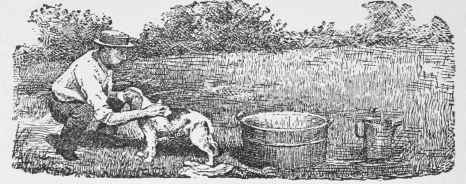
The skin of a robust dog that has ample exercise is generally in a good, healthy condition and rarely requires washing, for he often induces free and profuse perspiration during his runs and so flushes the pores, while by occasional swims and rolls in the grass he manages to keep the surface and hair fairly clean. But with him that is chained most of the time or otherwise closely confined frequent washing is imperative, for the thin, fine scales that are exfoliated in abundance and the accumulations of dust and dirt choke up his pores, and so dam up the effete matters as well as impair the activity of the myriads of little glands upon the integrity of which greatly depends the health of the skin and hair.
It is scarcely necessary to urge that the effects of un-cleanliness are both local and general, or in other words its functions being interfered with not only is the skin itself and all it holds more or less unhealthy but the general health is invariably below the standard. Moreover, the scales and other accumulations excite itching, and the scratching in turn produces eczema and kindred eruptions. And when this cause - lack of cleanliness - is active and persistent the injurious effect upon the hair is very pronounced, it being dry, staring and lustreless.
While washing is the most effective means of maintaining cleanliness its frequent application is decidedly objectionable, especially if soaps of ordinary quality are used, for the hair and skin must become too dry in consequence of being obliged to part with much of the oily matter which keeps them supple and smooth; hence it should be resorted to only when cleanliness can in no other way be secured or it is demanded as a remedial measure, as in cases of vermin and cutaneous diseases.
Under ordinary circumstances frequent grooming will be quite sufficient to maintain cleanliness and health of the skin and hair, and he who expects to keep his dog in the "pink of condition" must faithfully apply it not less often than once a day.
The brushes should be of bristles always, and what is called the "dandy brush" for short-coated dogs, while for the long-coated the bristles must be nearly if not quite an inch and a half in length, in order to pass through the coat and reach the skin.
Instances in which a fine-tooth comb is required are very rare indeed; and this is fortunate, for except in the hands of a most careful person it is sure to irritate the skin as well as seriously endanger the coat. The comb of the kennel, therefore, should be of the coarsest kind - its teeth being widely set and very blunt at the ends.
And mindful of the fact that parasitic diseases are quite common among dogs, also that they are frequently present for a long time before they are detected, the careful owner of two or more dogs will provide toilet articles for each. He will, moreover, clean them frequently by placing them for a few minutes in a shallow pan containing a disinfectant.
The brush will meet all positive requirements, but there are certain accessories which must be resorted to if a fine coat is to be made "cherry ripe," and these are gloves of woollen yarn or hair - the latter for choice - and the bare hands.
To first brush long and well, then rub diligently with the gloves, and finally with the bare hands, are the secrets of the toilet, and by faithfully applying the principles embodied in them cleanliness of the skin can be maintained, the hair stimulated to healthy growth and made to shine like satin if it is naturally fine.
The brush and gloves should be applied the one way always, and with, not against, the hair, but in using the bare hands on dogs which ought to have a "bossy muscle," as bull-dogs, bull terriers and greyhounds, the thighs must be rubbed both ways - up as well as down and afterward the ruffled hair be made right by brushing one way and hand rubbing one way. And lest the reader assume that the use of the bare hands is the least important of these measures the fact is urged that it is of the first importance in putting the coat of a fine-haired dog in prime condition, for by this means only can it be given the highest finish and lustre.
In washing, as in other departments of management, knowledge, care and judgment must often be displayed, notwithstanding it may seem to the average reader that it is simple and easy always. Very likely it is all this with short-coated dogs, but with those whose coats are long, soft and silky, glistening and brilliant, it is an entirely different matter, and to wash all varieties in the same way would be to ruin the coats of many completely.
For instance, the coat of a mastiff, bull terrier or pug could scarcely be injured in the tub, nor would these dogs be likely to take cold after a bath were a reasonable amount of intelligence and consideration exhibited with them, but the novice who undertook to wash a collie might make bad work of it, and certainly the chances would be all in favor of ruining not only the coat but the health of his subjects were they Maltese or Yorkshire terriers.
Obviously no one line of procedure can be established which will extend to all cases, nor is there much in this fact to be deplored, for with a few simple general rules in sight, a knowledge of the methods to be employed with the common varieties, and a fair amount of common sense, one need never run into a very dense fog.
Continue to:


My Books

