


Chapter VI. Earliest Puppyhood
Description
This section is from the book "Kennel Secrets: How To Breed, Exhibit And Manage Dogs", by Ashmont. Also available from Amazon: Kennel Secrets: How to Breed, Exhibit and Manage Dogs.
Chapter VI. Earliest Puppyhood
The first six weeks is practically a puppy's infancy, and during this, as in infancy proper, the mortality is far greater than in any other period of life, for the reason that the resistant powers are then very feeble and in conseqence the system is easily deranged and diseased. Considering which, notwithstanding the general rules of management have been discussed at length in the preceding chapters, the special requirements during earliest puppyhood will bear further emphasis, and even repetition can properly be indulged in if necessary to give due prominence to the important essentials.
The first fact to be enlarged upon is, that except in hot weather all very young puppies must have artificial warmth, not alone because they are poorly able to resist the depressing and destructive influences of cold, but because they are in imperative need of that extraordinary vivifying effect of warmth which reaches to all parts of the body and excites stronger and healthier action in every important organ. Indeed, so great is the susceptibility of the new-born to cold it can properly be said that it is hardly possible to keep them too warm, and certainly the degree of heat already advised for the whelping room cannot be any too great.
Obviously the period of greatest danger from cold exists in the first few hours after birth, while the little ones are wet with the amniotic fluid, yet even when they have dried and their own natural bodily heat has developed they are very easily chilled. Nor do they gain resistance rapidly, but continue in danger of this accident for at least three weeks - the degree, of course, gradually subsiding.
It will doubtless seem to some that the period of special liability to chilling having passed, puppies might with safety, even in cold weather, be put into stables, kennels or other buildings unfurnished with heating arrangements; and to believe this is made easier by the mistaken impressions which are so prevalent about the invigorating effects of cold. Without attempting to discuss these notions it is merely necessary to say that cold is to some degree invigorating to men and superior animals, provided their bodies have sufficient covering to retain the internal warmth and they are well developed, abundantly nourished, healthy and robust.
In all presenting these conditions cold will ordinarily tend to promote vigor and energy, but it can never do so when any of them are in considerable degree wanting; and certainly it cannot properly be considered other than inimical to the very young and very old, in whom the powers of resistance are invariably low.
Clearly, therefore, young puppies should not be exposed to cold excepting when they are sure to resist its depressing effects by free exercise. It is evident, moreover, that such exposures should not be of longer duration than the requisite exercise. And accepting this as essential to the preservation of the health of puppies, also the fact, too plain to be mistaken, that they cannot possibly thrive if they are denied the force-producing and vitalizing influence of heat, the conclusion is inevitable that they must have comfortably warm quarters throughout the growing stage.
Breeders are singularly reluctant to go thus far or acknowledge the entire truth of this; and while they may appreciate the importance of artificial heat in the first month of life, no small proportion of them, even during severe weather, put their puppies into unheated quarters as soon as they have been weaned, under the impression that they will be healthier and develop more rapidly there than they would were they kept warm. And, as might be expected, such breeders are never eminent successes, for these practices invariably tell sorely and result in impairment of the general health, constitution and growth, and in very many instances in deformities.
The writer is convinced that no more dangerous rock lies in the way of breeders, hence his efforts to give it every possible prominence. And to this end he draws from his experience in raising pugs.
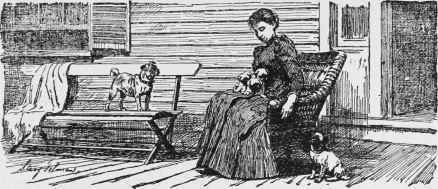
Some ten years ago he bought a small kennel of this breed for the young members of his family, who at once gave the little ones the freedom of the house. Not long afterwards he learned from various sources that pugs were very hard to raise and losses from almost every litter might be confidently expected. Yet notwithstanding the reputed high rate of mortality there have been whelped at his home over one hundred and fifty of these toys, and not a single one among them all has died. Of course there has been now and then a weakling, but such were all promptly disposed of, and, as stated, not a natural death has occurred in this wide experience.
The reason for this phenomenally good fortune appears in the fact that all whelpings occurred in the kitchen excepting when the weather was intensely hot; and until long after the weaning the youngsters rarely encountered a temperature lower than 8o°, while oftentimes during days it ran much higher than this in their corner, which was within two feet of the cooking range, and on several occasions, for the purpose of experiment, quite intense heat was kept up day and night for a week or more, during which times the little ones actually grew faster and became plumper, stronger and hardier than while the temperature was at the usual degree.
It is, of course, impossible to fix the temperatures which puppies require in their various stages of growth, for obviously the toys require a higher degree of heat than the big ones, and as a rule the short-haired a higher than the long-haired. But niceties of adjustment are not necessary, provided the degree is high enough, for it is scarcely possible to keep any puppy too warm during his first month.
As previously stated, after the weaning, and when some decided resistance to cold has been acquired, a lower temperature than 750 will in many instances be allowable, but in none ought it to fall more than five, or at the most ten, degrees before the puppies are five or six months old.
Continue to:


My Books

