


Chapter VI. Kennelling
Description
This section is from the book "Kennel Secrets: How To Breed, Exhibit And Manage Dogs", by Ashmont. Also available from Amazon: Kennel Secrets: How to Breed, Exhibit and Manage Dogs.
Chapter VI. Kennelling
Health is the dog's natural condition and he would rarely know any other were he given freedom and left to himself. But he is put under restraint, his supply of sunshine and pure air narrowed, and he is exposed to other unfriendly influences which must draw him away from Nature, - who is constantly struggling to keep him and all others in her domain free from ills, - and of these influences some of the most potent lie in the familiar and faulty kennel conditions.
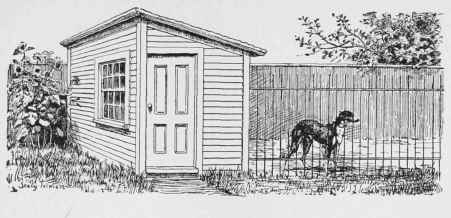
"Any place is good enough for a dog" is an expression which one hears with distressing frequency, yet it is scarcely more contemptible than the practices of many who pretend to care for him yet house him through all seasons in small boxes which scarcely afford more than mere covering, or in out-buildings, cold, draughty, damp, ill-kept and contaminated with emanations that must inevitably, sooner or later, undermine his constitution and impoverish his health, as well as make him a ready victim to inflammatory diseases.
No valid excuse can be given for faulty kennelling, no matter where the owners live or how poor they are, for he who is unable to provide suitable quarters for his dog elsewhere can share his own roof with him, and this no person of sense will be ashamed to do. But the problem of housing can scarcely be as easily disposed of in all instances, for there are quite a number of varieties of dogs which for their own welfare should be quartered beyond the living rooms of their masters; but still, the solution can be reached even where every trifling expense must be felt.
The most primitive kennel is a large and stoutly constructed barrel of the kind used in these days for alcohol, kerosene oil and many other fluids. This placed on its side and blocked up a foot or more from the ground by stones, bricks or wood, and with a wide board inside for a floor, would afford fairly good summer quarters for a small dog, which if unchained during the mild season would not likely seek shelter except in stormy weather.
But while such a device might answer its purpose there are not many owners, even among the poorest, who would be content with it, nor has it any advantages beyond those of a packing case or "dry-goods box" of goodly size if the top and sides of the same are covered by tarred paper. And the latter is certainly more sightly, while its cost is less than that of a barrel.
These boxes are used altogether for summer quarters by some breeders of varieties of medium sizes who place them about in the yards, providing one for each dog; and theirs is certainly a commendable custom, for dogs so treated are nearer nature, therefore healthier than they would be in stables, barns or large kennels. Moreover, as such boxes are inexpensive they can be burned and replaced occasionally during the season, and the necessity of whitewashing or using disinfectants and insecticides thereby obviated.
A small house could easily be constructed by any one accustomed to the use of tools, and for a sum but slightly in excess of what a good box or barrel costs; but to insure comfort it would be necessary to build on a different plan than that so generally considered suitable for small out-door kennels.
The prime essentials in such a building are, amply sufficient space for the tenant to stand and turn easily, and protection from draughts.
The latter can only be met by building the kennel very wide - in fact nearly double the width required merely for sleeping quarters - and in this way provide a hallway, as it were, which the tenant must enter from the outside and pass through before he can reach his room.
In the construction of kennels of this sort "matched boards" are generally used and tarred paper put in for lining, but while warmth is secured there are decided objections to this lining, for moisture accumulates between it and the boards, and the quarters are damp for many days after a hard rain. Consequently it is best always to "batten" over the joints or put on shingles.
A small window in his room and facing his master's house would be the desire of the tenant had he voice in the matter, and were this put in and provisions made for a storm window for cold weather the quarters would be much healthier for it.
There are several ways in which convenience in cleanliness may be favored: one, to hinge one-half of the roof to the other half, by which means it can be lifted as the lid of a box; another, to "cut in" a door in front, at the side of the hall-way door; but the best of all is to have the entire front hinged at the top so that it can be raised, when it will be easy to clean all parts inside.
The kennel completed and in place, a large platform should be built in front that the tenant may sun himself without being obliged to lie upon the ground.
Such a building as this properly situated, kept clean, etc., would be comfortable quarters for a dog in pleasant weather; and if long-coated and hardy and he had plenty of exercise in the daytime he might pass the winter nights in it were an abundance of bedding put in and a piece of carpeting tacked over the door. Yet it has literally nothing to recommend it except perhaps its low cost, while many serious objections appear, one of which is that it must inevitably be damp at times. Consequently, to consider it further, the best situation for it, etc., would be simply wasting time and space.
A loose box in a stable of stock will do nicely for sleeping quarters, but he who has neither this nor other suitable out-house should build for his dog something deserving the name of kennel. Consenting to do so he will consider first the great requisites, which are dryness, air, sunshine, freedom from draughts, protection from cold, and convenience.
If he has a choice of situations he should take the high ground as most favorable because of surface drainage, for nothing is more important in the construction of this, and for that matter every building, than that its foundation be protected from dampness, which, by the way, is an influence positively destructive to dogs.
Continue to:


My Books

