


Dog Judges, Exhibitors, Clubs, And Reporters. Part 2
Description
This section is from the book "Toy Dogs And Their Ancestors", by Neville Lytton. Also available from Amazon: Toy Dogs And Their Ancestors: Including The History And Management Of Toy Spaniels, Pekingese, Japanese, And Pomeranians.
Dog Judges, Exhibitors, Clubs, And Reporters. Part 2
It is not, I think, generally understood that, in order to win a challenge prize at a show, a dog need not be entered in the open class. The rule is this - that the dog must have been registered and have won a prise in his class at the show. It is therefore perfectly possible that a third-prize winner at the show should yet justly get a challenge prize. For instance, a dog entered only in novice class may be beaten by two bitches. He may, however, be better than any of the winners in open dog or limit dog, and would therefore win the dog chal- . lenge certificate in preference to the first-class winner in open class. Many judges and most exhibitors think that the challenge prize necessarily follows the award in open class, but this is an error.
As an illustration I may instance a case in point which happened at Crufts Show. In open bitches Caramel was placed first, but in limit (dogs and bitches) the awards were as follows:
1. Flashlight (dog)
2. Seetsu Prince (dog)
3. Gloire de Dijon (bitch) Reserve. Caramel (bitch)
The judge awarded the challenge prize to Caramel, who was first in open class against other bitches, but the owner of Gloire de Dijon, though only a third-prize winner, might have claimed it, as she beat Caramel in limit. Even had they not met in limit, she would have had a right to compete against Caramel for the challenge prize.
In spite of the rosy view taken by M. Jaquet in a recent interview with an illustrated paper, speaking of unfairness being now a thing of the past, I am afraid there is a good deal of "give and take " in the judging of many breeds. Human nature remains human nature in spite of Rule 17, and it is perfectly impossible to convict of fraud a man who puts up a dog he has just sold or bred, as he can always reply that in his opinion it was the best and there the matter is bound to end, though all the exhibitors may know perfectly well that the thing was "put up" beforehand, the matter being an open secret. Many dealers think this a perfectly legitimate way of selling their dogs to novices and consider any attempt to interfere with it as an absurd exhibition of jealousy or fastidiousness, and take it as deliberate and unjustifiable ill-nature, being entirely incapable of understanding that there is anything undesirable in it.
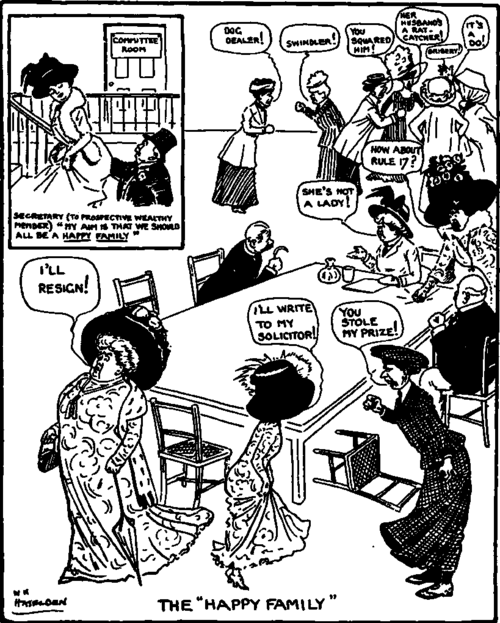
Meeting of the United Fanciers' Club
There are many fanciers who deplore the ways of the dog fancy as much as I do, but if they speak up they are put into Coventry and good-bye to all hope of winning with their dogs.
I shall take the bull by the horns as I do not belong to any specialist club, so I owe no allegiance to anybody, though I wish every success to any of those bodies who may be working for the good of their respective breeds, and not to fill their own pockets.
As I am on the subject of clubs I shall say a few words about specialist clubs in general and what I consider are their drawbacks both at home and abroad.1
The Illustrated Kennel News recently had a leader with regard to the evil influence of specialist clubs and individuals on the system of selecting judges. Specialist clubs are really far more dangerous than individuals, as they usually have many more thumb-screws with which to screw the thumbs of show committees and a greater glitter of challenge cups and medals wherewith to dazzle them; and whereas the individual schemer may attract an occasional minor moth to his candle, the revolving lights of the club light-houses attract even the cautious big birds by their brilliance. Acting in a body they are also more shameless in the tail twisting of committees than unsupported individuals.
Specialist clubs are, as a rule, merely the organs of a few more or less powerful exhibitors; almost invariably dealers of the less reputable kind who have some common aims, but whose interests are not by any means always in the breed they are supposed to represent, but, alas, in their own pockets. A foreign kennel club is sometimes affectionately referred to in the newspapers as the "Kennel Curse !" I do not know what has brought this upon its head, but I think that if the word "curse" were substituted for the word "club" in a great number of our specialist bodies here it would do them no great injustice.
1 Part of this was published by me in the Ladies' Field and Kennel News and copied by an American paper.
Their influence is all the worse because the best breeders and owners, who have a reputation to lose, usually prefer to be independent of such bodies, which may only represent the opinions of a few individuals with their own fish to fry, who impose their views upon their "club" judges under the plea that the "club" (otherwise the "curse") represents the breed. I greatly prefer a good, honest all-rounder, even if he does make mistakes, to a specialist chosen by these fish-frying committees. The club standards appear sometimes to be framed merely on the fancy of their founders or to suit a prevalent type, being based on no historical evidence whatever - the historical evidence in some cases being diametrically opposed to the club standards.
The club judges are allowed no liberty of opinion. Should one of them be ill-advised enough to indulge in any independent awarding of prizes, by which influential members find themselves among the V. H. C's, that judge is either not asked to judge again or else so severely hauled over the coals and given what is popularly called such a "dressing down" that he is not likely to forget it in a hurry. No man, unless he had the merest barley water in his veins instead of blood, would submit himself long to such dictation. He either leaves the club or refuses to judge and the club list dwindles at last to a few weak-minded toadies, who dare not go against the known wishes of their employers and don't care if they call their souls their own or not. Now this is not for the benefit of any breed.
Cheerful Meeting of a Show Executive Committee
The position of a judge in these specialist clubs is that of a child in leading strings. The judging of some breeds has long been a perfect farce; the dealers play into one another's hands, appoint each other as judges and report on their own dogs. Could anything be worse for the improvement of our breeds of dog? The results are disastrous. No wonder we get amazing exaggerations - no wonder type is lost and quality forgotten. No wonder respectable people are driven out of the shows, I have seen new breeders rise up with money and energy, full of kindliness, honesty, generosity, and enthusiasm, and in six months they have been swindled out of their generosity, in eight months their kindliness has been bullied out of them, in ten months they have been forced out of their honesty, in twelve months their enthusiasm has turned to bitterness and they have either sold up their dogs and gone from the ring for ever, or they have joined the various cliques of swindlers in desperation and become as bad as any of them.
Continue to:


My Books

