


Type And Standards. Part 12
Description
This section is from the book "Toy Dogs And Their Ancestors", by Neville Lytton. Also available from Amazon: Toy Dogs And Their Ancestors: Including The History And Management Of Toy Spaniels, Pekingese, Japanese, And Pomeranians.
Type And Standards. Part 12
In looking at a dog full face, his eyes should not be set so that they seem to be round the corner of his head.
Whether the noses are long or short, the dog must be "up-faced" - that is to say, that there must be an upward tilt to the end of the nose. Without this the expression cannot possibly be right, no matter how the rest of the head is constructed. This can be overemphasized, like every other point, as where the finish is so excessive that the top of the nose reaches above the level of the top of the eyes. This, however, is a less objectionable fault than the down-face. The expression cannot be right, either, if the eyes are in any way oblique or crooked.
To test the straightness of your dog's eyes, put your head on a level with his and look him full in the face when he has his eyes shut. Carry an imaginary horizontal line through his nostrils. The slits of the closed eyes should be perfectly horizontal. If they deviate in any way whatever from it, they are wrong.
For Blenheims and Tricolours smutty faces covered with brown specks are most disfiguring, and should not be encouraged. The muzzle should be pearly white and clean and entirely free from any admixture of brown or black hairs.
A glance at the representation, in Cassell's book, of Mr. Naves's King Charles, Covent Garden Charlie, will show how much the modern type has altered for the worse. It will also be seen that the tan was very bright and extended right over the muzzle, and that the feet and feathering were also bright red. The dog is full of a style and quality which is almost unknown in the present day King Charles, and the same applies to Mr. Naves's Ruby, "Shepperl." Where do we see such ears nowadays?
I would here point out that the coats of Toy Spaniels are being ruined by the craze for absolutely straight hair, which has brought upon us from America the accusation of resorting to Japanese crosses in order to secure the fashionable coat. Now even the Toy Spaniel Club says that a Toy Spaniel's coat should be "soft, silky, profuse, and wavy." There is no doubt whatever in my mind that the original ancestor of the Black-and-tan was curly. The tendency there is in the breed to revert to curly coats is most marked. The deplorable result of the modern rage for straight coats is that they now are neither silky, soft, nor profuse, and one sees dogs come into the ring with harsh, spiky coats, or, more often, no coat at all. I wish breeders and judges would remember that the chief object of a pet dog is that the coat should be as soft as swansdown, and that there should be plenty of it.
When judging, I have been astonished at the hardness of some of the Toy Spaniel coats; they might have been Terriers. Instead of the deliriously soft and silky fur which should be there, one meets with a substance more like grass or hay than hair. A Toy Spaniel's coat should feel like a mixture of floss silk and swans-down; it should not feel like human hair under the fingers, nor should the body coat be short, like that of a horse, and it must not be Japanese, either. This last form of a coat is a snare to judges, as it is very pretty, and, though infinitely preferable to no coat at all, is absolutely wrong, unless we wish to go right back to the Chinese ancestor. This coat probably does come from the Japanese crosses, or is a throw-back. There was a similar coat in the breed of Toy Spaniel mentioned by Buffon, of which I have only been able to trace one specimen in England. This was a very interesting stuffed dog, about one hundred years old, which I had the pleasure of examining. It was black and white, with faint tricolour markings over the eyes; the nose moderately short, very pointed and tapering; the ears immensely long and twisted into ornamental tassels, and about thirty inches from tip to tip.
The bones were very fine and small, and the coat exactly similar to that of a Japanese dog. This specimen also had a perfect spot about the size of a shilling on its head; it was the precise type of Buffon's Epagneul, only larger, being about twenty pounds in weight.
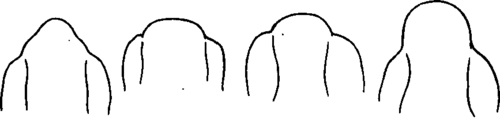
Different Shapes of Skull

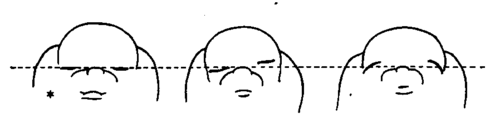
Various Positions of the Eyes of a Toy Spaniel when Shut
The one marked * shows the proper position
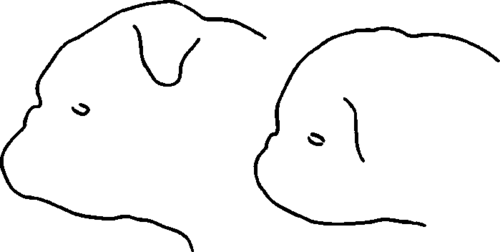
Outlines from Photographs of a Bulldog and a Noseless Ruby Spaniel of the Bulldog Type showing Likeness in Formation of Skull
Most of our dogs now are suffering from an inbred degeneracy of the hair follicles, and, if we want to save the breed from getting universal rat coats and losing the long, characteristic feathering beyond recall, my strong advice is to breed from the few profusely coated specimens which we have and leave the poor-coated specimens severely alone. Never mind curls; they are a sign of a strong growth of hair and a healthy skin. Curly coated dogs are, in my experience, infinitely less liable to skin diseases than those with straight coats. The growth of hair upon Toy Spaniels is getting weaker and weaker. Almost all the dogs whose coats are perfectly straight have a type of coat which is of an entirely wrong texture, and I consider that a perfectly straight coat should be penalized for this reason. Coats should be very wavy and very soft, not wiry and straight. The coats of our present Ruby Spaniels are most objectionable.
Speaking of the Blenheim, Dalziel says that it should not be curly, and inherits this fault from the King Charles (i. e., the Black-and-tan), so he evidently knew that the King Charles Black-and-tan was a curly dog, though he persists in advocating that its coat should be straight.
Continue to:


My Books

