


Type And Standards. Part 17
Description
This section is from the book "Toy Dogs And Their Ancestors", by Neville Lytton. Also available from Amazon: Toy Dogs And Their Ancestors: Including The History And Management Of Toy Spaniels, Pekingese, Japanese, And Pomeranians.
Type And Standards. Part 17
Ears very long and wide in leather, and profusely feathered with strongly wavy hair, and set rather high and carried forwards, framing the face like the curls of Leech's early Victorian young ladies, but not set higher above the eyes than the depth of the muzzle. Neck well arched, especially in the male dog. Shoulder nicely sloped. Back short, perfectly flat, and wide, the quarters also quite square and flat, seen from above, and also as seen from behind. The tail firmly set into them on a level with the line of back, and carried gaily, though not straight up in the air at right angles to the back, or curled over it. It should be well furnished with long hair, and, as the standard already says, constitute a flag of a square shape.


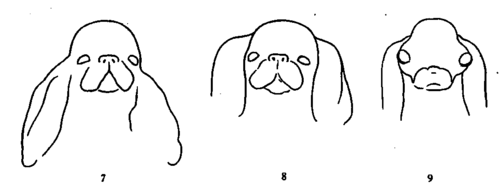
Heads to Avoid, with the Defects purposely Emphasised
Drawings by J. Lytton
1. Muzzle too deep and lippy. 2. Muzzle too wide and froggy. 3. Muzzle too low and sunk. Eyes oblique. 4 and 6. Under jaw too prominent.
5. "Grand massive" type, with dewlaps. Much favoured by men judges.
7. Skull too high. Ears too low. Eyes oblique, the reverse way to No. 3. Muzzle too deep.
8. Another massive type.
9. Eyes sec at corners of head, with hollows under them. Nose too low. Bad muzzle and skull.
Body short, compact, and solid, and legs short, but not so short as to make the body appear long. Chest wide and deep. Ribs well arched and wide, bone very fine and delicate, not heavy as in a modern sporting Spaniel. This fineness of bone is most important
Feet and legs well feathered with silky hair. Immense frills on chest, neck and breechmgs, also on tail and underneath the body. The whole dog should show an extraordinary style and quality. A dog may have almost every show point and yet lack quality, and if he lacks quality he should not win.1
1 For explanation of the word quality see above.
Coat very profuse and feeling like something between floss silk and swansdown. In the Blenheim it should be wavy, and in the Tricolour it may be either curly or wavy (though I myself do not like a very curly coat), but not Japanese in quality or perfectly straight, though I would not disqualify a straight-coated dog if the coat was soft and very profuse.
The short hair on the forehead and muzzle of the Blenheim should not be too flat, but should rise very slightly from its roots so as to give a very furry and soft appearance.
In the Black-and-tans the coat may be curly and have more body in it than the straight coat; the curl should be distinct and regular, not mixed and stringy or very tight; the ears and feather should be very long, and the feather on the chest and breechings should be straight or wavy, not too curly. I myself prefer a wavy coat, as curls do not suit a very short face. The Black-and-tan is not the true King Charles, which has a long nose.
Size
The best size is that where the dog is as small as possible without losing symmetry, strength, or compactness. The best height is from eight to ten inches at the shoulder, and a well-built dog weighs approximately rather more than one pound for every inch of his height. No dog should exceed twelve inches in height and must be well proportioned and short in body, though not leggy. Seven pounds to ten pounds is a sensible weight, but some ten-inch dogs weigh twelve to fourteen pounds. Though so solidly made, the dog should be wonderfully light on his feet, and a brilliantly active mover.
Colour
Colour in the Blenheim should be red and white, and the white should be of a peculiar pearly quality, not a blue or grey white. The red should be a very red, golden chestnut; this is the prettiest; the deep sienna is not so good. A pale or lemon colored hue is quite correct historically, though I do not like it myself. The markings should be evenly distributed in clear patches and as little mixed as possible. The muzzle should be also pearly white, and a white blaze should extend up the forehead, in the middle of which should be a circular spot of red, the size of a sixpence. The ears and cheeks red with a golden red sheen. The eye points, as I have said, perfectly black and broad on the lids. Very few ticks of red are allowed on the muzzle, forehead, and legs, but are not desirable in my opinion when on the face.
The Black-and-tan should be a deep glossy black with liberal tan markings over the eyes, round the cheeks, over the whole muzzle and part of the breast, in a fan shape, and also on the paws, all the featherings of the legs, and linings of ears, thighs, and tail. The tan should be a brilliant burnt sienna colour. A white breast should be no disqualification, but a large white patch on the head or body should be heavily penalised to disqualification. This is for the modern type of Black-and-tan, but the true King Charles should be all black with white breast.
The Tricolour should be marked like the Blenheim (see above), only in black instead of red, and should also have the spot on the top of the head which is historically characteristic of the black and white. It was also a characteristic of the Springer. It should have a brilliant tan over the eyes, linings of ears, cheeks, and tail; and the feathering of breechings should be white or else composed of a mixture of red, white and black, the white, however, predominating. A few ticks of red and black on the legs and face are allowable, and the black markings, where they end on the inside of the fore tegs and thighs underneath the body, should be also lined with red.
The Ruby should be a rich burnt sienna red or a brilliant golden chestnut, which are both equally beautiful, but the colour must never be dull or dusty. It may have a white breast and feet, but those with white blazes might be penalised unless otherwise perfect. A perfectly marked head should only win from an imperfectly marked one if in other points equally good.
The rims of the eyes, as in other varieties, must be black; also the nose, which must on no account be yellow, red, grey, or flesh-coloured.
I think, to meet the question of so-called "mis-marked " dogs, that a class might be provided at shows, in addition to the regular classes, where these dogs might compete together under " any other colour." The judge could, at his discretion, award challenge prizes to any dog in this class which he considered better than those in the regular classes.
As to the question of registration, there would be no more difficulty about this than there is at present, when the dogs are always registered under one of the varieties.
A circular white spot, the size of a sixpence, on the skull, as is sometimes seen, should be cultivated as a variety of the Blenheim spot. The Ruby being the outcome of a cross of Red-and-white, it must be remembered that it is an artificial colour, and that to produce dogs with no white at all means inbreeding to an undesirable extent, so that we should endeavour not to eliminate the white altogether, but to adapt it, if possible, to the requirements of beauty. The tendency to white on the head could easily be utilised to produce the spot instead of a streak, which would be a great added beauty, the plain red being a rather uninteresting colour in the opinion of most ladies who are not trained fanciers. A Ruby with white toes and the spot generally proves most attractive to the pet hunters, in spite of all the rules of the Toy Spaniel Club. I have seen several Rubies with the spot in white.1
Continue to:


My Books

