


Section X. - Polygons. 431. - Relation Of Sum And Difference Of Two Lines
Description
This section is from the book "The American House Carpenter", by R. G. Hatfield. Also available from Amazon: The American House Carpenter.
Section X. - Polygons. 431. - Relation Of Sum And Difference Of Two Lines
Let AB and CD (Fig. 285) be two given lines; make EH equal to A B, and HG equal to CD; then E G equals the sum of the two lines.
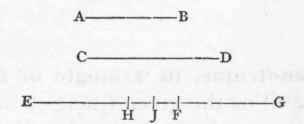
Make FG equal to A B, which is equal to EH.
Bisect E G in J; then, also, J bisects HF; for -
EJ=JG, and -
EH=FG.
Subtract the latter from the former; then -
EJ- EH= JG-FG;
but -
Ey-EH=HJ,
and -
JG-FG = JF;
therefore - .
HJ=JF.
Now, E J is half the sum of the two lines, and HJ is half the difference; and -
Ey-HJ=EH=AB.
Or: Half the sum of two quantities, minus half their difference, equals the smaller of the two quantities.
Let the shorter line be designated by a, and the longer by b; then the proposition is expressed by -
a =a+b/2 - b-a/2 (128.)
We also have E J + JF= EF = CD; or, half the sum of two quantities, plus half their difference, equals the larger quantity,
Continue to:


My Books

