


Bond Of Arches
Description
This section is from the "Practical Building Construction" book, by John Parnell Allen. Also see Amazon: Practical Building Construction.
Bond Of Arches
The bond of arches is not generally so intricate as that of walls, etc.; though there must necessarily be some system of binding the component parts together. Before entering into this subject, however, it is necessary to point out that brick arches are described by the number of rings or half-brick rings in which they are built - a ring indicating a course of the arch struck from the centre.

English and Flemish bond, in arches formed of a single-brick ring, are alike in elevation, being similar to fig. 143, the usual well-known difference only occurring in the arrangement of the bricks from the face as appearing on the soffit; fig. 144 being the plan of the soffit (as seen from underneath) of an English bonded arch; and fig. 145 that of Flemish bond.
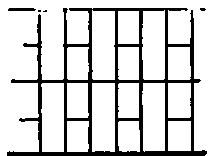
Fig. 144.
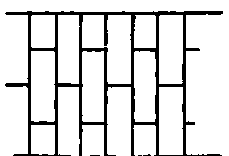
Fig. 145.
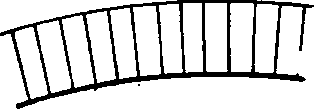
Fig. 146.

Fig. 147.
Heading bond, in an arch of a single-brick ring, is illustrated by fig. 146; but the most practically bonded arch (which has also the best appearance) is the brick-and-a-half-ring arch shown in fig. 147.
Half'brick-ring arches, such as that depicted in fig. 148 - formed of several half-brick rings - show a finer joint, with less labour, and they are the most easily built; but in big spans the rings are apt to separate from each other at the coursing joint, from want of bond. This absence of unity and solidity frequently becomes a source of weakness; and in order to guard against such defects in heavy arches, a few courses must be bonded occasionally, when the heading joints which radiate are in line so as to allow of it, as in fig. 149, for half-brick rings; but a more complete and stronger arch than this can be made by superseding the half-brick ring entirely, as shown in fig. 150, for an 18-inch or 2-brick arch.
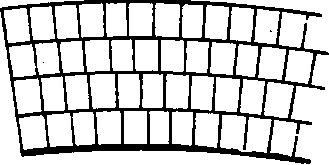
Fig. 148.

Fig .149.
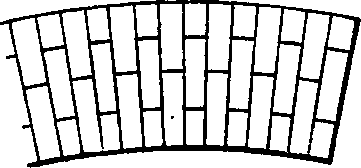
Fig. 150.
Larrying, as applied to brickwork, is the term used for pushing up the bricks within the outsides of thick walls into their position, collecting mortar to form the joint, as they go along, from a rough quantity that has been thrown in.
Grouting consists in pouring mortar (of the consistency of cream) over the top or last course of three or four successive courses which have not been properly jointed. The semi-fluid mortar runs into all crevices that may have been left, and forms the whole, when set, into one solid mass.
Dinging is the term used to describe the brushing over of the brickwork with a wet brush while the mortar is damp after being "struck fair."
Wigging is a term employed in Dublin to denote the facing treatment applied to the rough bricks used there, the vertical joints being filled up with blue mortar and the horizontal ones with red, the whole being afterwards pointed with a white cut joint.
Continue to:


My Books

