


Design Of Riveted Girders
Description
This section is from the book "The Building Trades Pocketbook", by International Correspondence Schools. Also available from Amazon: Building Trades Pocketbook: a Handy Manual of reference on Building Construction.
Design Of Riveted Girders
For heavy loads and long spans, plate girders are substi-tuted for rolled beams. A plate girder consists of a web-plate, with stiffeners, if required, and of the upper and lower flanges, as shown in Fig. 20.
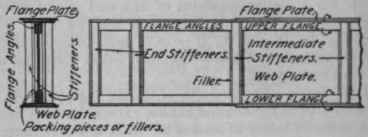
Fig. 20.
Loads upon a plate girder develop shearing stresses, resisted by the web-plate, and horizontal compres-she and tensile stress
1 by the upper and lower flanges. The usual cross-sections of plate girders are shown in Fig. 2l. The single-webbed girders (a) are the most economical in material, and the most accessible for painting and inspection. The box girders (b), however, may be used to advantage where a wide top flange is required for lateral stiffness.
Proportioning Web
The width of the web-plate governs the depth of the girder, which, to avoid excessive deflection, should not be less than 1/15 the clear span, although some authorities permit 1/20 If made more shallow, the sectional area of the flanges should be increased, so as to reduce the stress on them, and the deflection in proportion.

Fig. 21.
The thickness of web-plates depends upon the shear, which is greatest at the supports. This thickness must be such that the internal resistance to shear - found by multiplying the area of cross-section of web by the safe unit shearing stress - shall be equal to the maximum shear on the girder; that is, if A be the area of cross-section, in square inches; s, the safe unit shearing stress; and S, the maximum shear, then As = S; but as A is equal to the thickness (t) in inches multiplied by the net depth (d'), in inches, td' s = S.
or t = S/d's. Hence, the necessary thickness in inches of web is equal to the maximum shear divided by the product of the net depth of the girder in inches times the safe unit shear. The net depth is the width of the web minus the sum of diameters of all rivet holes in a vertical line at the end stiffeners. The safe unit shear is usually taken at about 3/4 the safe horizontal stresses; or, for steel girders in buildings, about 11,000 lb. per sq. in. In no case should the web be less than 5/16 in. thick.
Example
Fig. 22 shows the end of a girder, the greatest reaction being 120,000 lb.; with an allowable unit shearing stress of 11,000 lb., what should be the thickness of the web-plate?
Solution
The width of plate Is 48 in., and there are 13 - 3/4" rivet holes. Allowing 1/8 in. for punching each hole, the net depth is 48 in. - (7/8 X 13) = 36 5/8 in. Applying the formula, t =120,000 / (36 5/8 x 11,000) = .297 in. As this is less than 5/16 in., the latter thickness is used.

Fig 22.
Continue to:


My Books

