


Table VIII Strength Of Metals In Pounds Per Square Inch
Description
This section is from the book "The Building Trades Pocketbook", by International Correspondence Schools. Also available from Amazon: Building Trades Pocketbook: a Handy Manual of reference on Building Construction.
Table VIII Strength Of Metals In Pounds Per Square Inch
* Unit stress producing 10% reduction in original length.
Ultimate Tensile. | Ultimate Compression. | Ultimate | Modulus of Rupture. | Modulus of Elasticity. Millions. | |
Wrought iron................ | 50,000 | 44,000 | 44,000 | 48,000 | 27 |
Shape iron................ | 48,000 | 26 | |||
Structural steel.......... | 60,000 | ||||
65,000 | 52000 | 52,000 | 60,000 | 29 | |
Cast iron.................... | 18,000 | 81,000 | 25,000 | 45,000 | 12 |
Steel, castings.............. | 70,000 | 70,000 | 60,000 | 70,000 | 30 |
Brass, cast..................... | 24,000 | *30,000 | 36,000 | 20,000 | 9 |
Bronze, phosphor................ | 50,000 | 14 | |||
Bronze, aluminum............. | 75,000 | 120,000 | |||
Aluminum, commercial | 15,000 | 12,000 | 12,000 | 11 |
Table IX. Strength Of Timber In Pounds Per Square Inch
1 | 2 | 3 | 4 | 5 | 6 | 7 | |
Material. | Ultimate Tensile with Grain. | Ultimate Compression Parallel to Grain. | Allowable Com. Perp. to Grain. | Ultimate Shearing. | Modulus of Rupture or Extreme Fiber Stress. | Modulus of Elasticity. | |
Parallel to Grain. | Perpendicular to Grain. | ||||||
White oak........................................................ | 10,000 | 4,500 | 700 | 800 | 4,000 | 6,000 | 1,100,000 |
White pine ...................................................... | 7,000 | 3,500 | 250 | 400 | 2,000 | 4,000 | 1,000,000 |
Southern, Long-Leaf, or Georgia yellow pine | 12,000 | 5,000 | 600 | 600 | 5,000 | 7,000 | 1,700,000 |
Douglass, Oregon, and yellow fir................ | 12,000 | 6,000 | 400 | 600 | 6,500 | 1,400,000 | |
Washington fir orpine red fir....................... | 10,000 | 5,000 | |||||
Northern or Short-Leaf yellow pine............. | 9,000 | 4,000 | 350 | 400 | 4,000 | 6,000 | 1,200,000 |
Red pine ......................................................... | 9,000 | 4,000 | 250 | 5,000 | 1,200,000 | ||
Norway pine................................................... | 8,000 | 4,000 | 250 | 4,000 | 1,200,000 | ||
Canadian (Ottawa) white pine...................... | 10,000 | 5,000 | 350 | ||||
Canadian (Ontario) red pine.......................... | 10,000 | 5,000 | 400 | 5,000 | 1,400,000 | ||
Spruce and Eastern fir................................... | 8,000 | 4,000 | 300 | 400 | 3,000 | 4,000 | 1,200,000 |
Hemlock ......................................................... | 6,000 | 4,000 | 250 | 350 | 2,500 | 3,500 | 900,000 |
Cypress............................................................ | 6,000 | 4,000 | 250 | 5,000 | 900,000 | ||
Cedar............................................. | 8,000 | 4,000 | 250 | 1,500 | 5,000 | 700,000 | |
Chestnut.......................................................... | 9,000 | 5,000 | 350 | 600 | 1,500 | 5,000 | 1,000,000 |
California redwood........................................ | 7,000 | 4,000 | 300 | 400 | 4,500 | 700,000 | |
California spruce............................................ | 4,000 | 5,000 | 1,200,000 | ||||
The values for different woods in Table IX are average values for commercial timber. Column 3 in the table shows the ultimate compressive strength parallel to the grain, which values are used in figuring the ultimate strength of columns. Column 4 gives the allowable compressive strength perpendicular to the grain, the values given being the load per square inch of section required to produce an indenture of 1/100 of an inch. Reference to Fig. 1 will explain this more clearly. The left-hand portion of column 5 will be found of use in calculating the resistance of the timber at the heel of a roof truss. For instance, in Fig. 2, to calculate with what force the piece c of the tie member 6 opposes the thrust of the rafter member a. The sectional area of the surface d e f is 10 in. X 18 in. = 180 sq. in. The ultimate shearing strength of Georgia yellow pine, parallel with the grain, according to Table IX, is 600 lb.; then, 180 x 600 = 108,000 lb., the ultimate strength of the timber. If the safe strength is desired, divide by the required factor of safety; if 4 is used the safe strength will be 108,000 / 4 = 27,000 lb. Column 6, giving the modulus of rupture for different woods, is used in figuring the strength of beams (see page 106).
From recent tests to determine the physical properties of timber, made by the Forestry Division U. S. Dept. of Agriculture, the following conclusions are deduced: That the bleeding of long-leaf yellow pine, for sap products, is not detrimental to its durability and strength; that moisture reduces the strength of timber, whether that moisture be the sap or that absorbed after seasoning; also, that large timbers are equal in strength to small, provided they are sound and contain the same percentage of moisture.
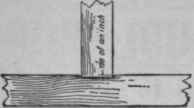
Fig. 1.

Fig. 2.
Continue to:


My Books

