


Hand-Moulding After Mechanical Preparation Of The Paste
Description
This section is from the "Architectural Pottery" book, by Leon Lefevre. Also see Amazon: Architectural Pottery.
Hand-Moulding After Mechanical Preparation Of The Paste
There are some brickworks whose annual production is as much as ten millions, and which are worked by hand. This large quantity of bricks requires a daily consumption of vast quantities of material.
It is advisable, in order to reduce as far as possible the cost, to prepare the paste mechanically, and to transport it cheaply to the place of manufacture. The plan and section in Fig. 86 show an installation of this type, furnished with two pug-mills similar to those represented in Fig. 63.
The clay when extracted from the pit is loaded on little waggons and taken to the pug-mills by an inclined plane ff. This inclined plane is easily removed and, with a sufficiently long cable, covers a large radius. It may be replaced by an endless belt sloping downwards, on which the clay brought by the waggons is thrown. In front of, and at the same height as, the issuing orifice of the pug-mills are flat cars which run on rails from the mills to the place of moulding. Each car carries enough to make from 100 to 150 bricks; they follow one another without interruption, and are so arranged that the moulding is carried out on the platform of the car itself.
The pug-mills are worked by a stationary engine, and produce per hour a sufficient quantity of paste to make 2000 to 2500 bricks. The net cost, extraction not included, which is the same in both cases, is estimated as follows; it may be remarked, however, that the cost of labour, which is put down as 30 to 50 centimes an hour, is capable of reduction.
Brick-Making Installation For A Daily Production Of From 40,000 To 50,000 Hand-Made Bricks
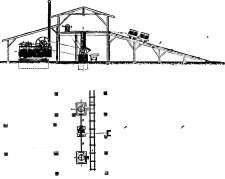
Fig. 86. Section and Plan.
The economy which may be realised amounts to the difference between 4 or 5 francs, price for piece-work, and the sum mentioned below, that is to say, 1 or 2 francs per 1000, and from 10,000 to 20,000 francs for the 10,000 manufactured annually.
Francs. | |
Material. - A 20 horse-power engine..... | II,000 |
2 pug-mills, at 2500 fr.... | 5,000 |
1 windlass and cable.. | 300 |
8 waggons for transport, at 100 fr. ... | 800 |
30 waggons with platforms, at 60 fr. .... | I,8oo |
Transmission of power and belting............ | 300 |
500 metres of rail, .50 m. gauge, at 3 fr. 20 | 1,600 |
2 sets of points.... | 180 |
12 turn-tables, at 40 fr. ... | 480 |
Structure and inclined plane... | 2,500 |
840 | |
Sundries.... | 200 |
25,000 |
Francs. | |
Interest at 4 per cent. | IOOO |
Sinking-fund at 10 per cent. | 25OO |
3500 |
Labour, etc. -9 moulders, at 5 fr. ... | 45 fr. |
9 boy mould-carriers, at 3 fr. ... | 27 |
4 boys to push waggons, at 3 fr. | 12 |
4 men to stack the bricks, at 4 fr. .... | 16 |
4 boys to edge off the bricks, at 3 fr...... | 12 |
1 engine-driver.... | 5 |
Coal, 400 kil. at 25 fr. per 1000.... | 10 |
Oil, repairs, etc.... | 5.50 |
132.50 |
That is to say per thousand: 132fr.50/50 = 2fr.65.. | 2.65 |
The cost of manufacture, with interest and depreciation, comes then to... | 3.00 |
Continue to:


My Books

