


Correction Of The Defects Of A Single Lens
Description
This section is from the book "Photography", by E. O. Hoppe, et al.. Also available from Amazon: Photography.
Correction Of The Defects Of A Single Lens
Chromatic Aberration is corrected by combining a negative lens, 2, Fig. I9a, with a positive lens, 1, the glass of the negative lens having greater dispersive power than the glass of the positive lens. Such a combination can be selected to give the required deviation without much dispersion, the condition being that the dispersive powers are proportional to the focal lengths. It is not possible with such a combination to bring all the coloured rays to the same focus, so it is usual to correct for the most chemically active and visually affective. If more than two lenses are used with a corresponding variety of glasses, it is possible to obtain a combination which is approximately corrected for all colours.
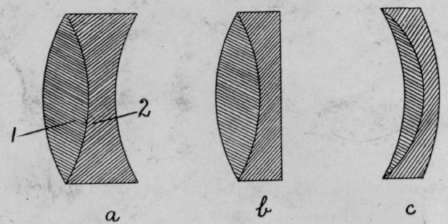
Fig. 19.
Spherical Aberration is corrected by varying the shape of the components of the achromatic combination, it being necessary to select two lenses in which the positive error of the one equals the negative error of the other. The correction is, however, not perfect. The most common forms of single achromatic lenses are shown in Figs. 19a, 19b; but the form shown in Fig. 19c is better corrected, and can be used at a larger aperture. The use of a stop with a single achromatic lens is a necessity, and it must be of such size and position that the centre of the image is only formed by centric pencils, and the margins of the image by oblique excentric pencils. Single achromatic lenses of only two components and medium focus can be designed to cover sharply a quarter plate at F 11. More complex single achromatic lenses can also be corrected for astigmatism. Distortion is corrected by placing two single achromatic lenses co-axial as shown in Fig. 21 with a stop between them. If the stop s is placed between the lens L and the object O, as in Fig. 20, the image I is shaped as shown; but, if the stop s is placed between the lens L and the image I, the image takes the shape shown at I', Fig. 20. Obviously if two single achromatic lenses are placed as in Fig. 21 with a stop between them, the distortion created by the front lens is nullified by the opposite distortion created by the back lens. Such a lens is said to be Orthoscopic or Rectilinear. They are usually constructed to work at f8; but some are made to work at F5.8 and are particularly useful for portraiture. These largeapertured rectilinears are known as Euryscopes, Biplanats, etc., but, when used on a fairly large plate they must be stopped down to give good marginal definition. They are usually mounted so that one component can be removed, leaving a lens of about double the focal length of the combination. The use of a longer focus lens is advantageous in portraiture, and in some classes of landscape work.
Portrait Study.
Rudolph Duhrkoop, F.R.P.S.
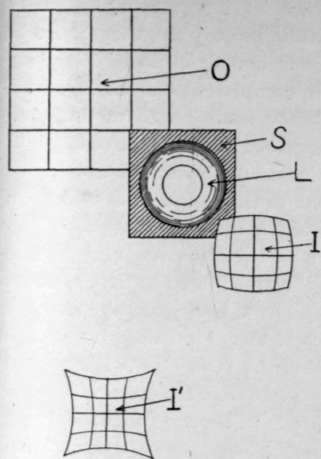
Fig. 20.
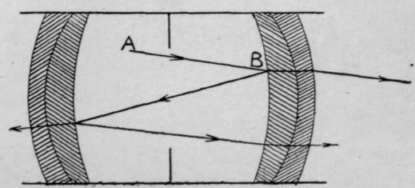
Fig. 21.
Anastigmat
We now come to that type of lens known generally as the Anastigmat, which indicates that it is free from astigmatism. The forms of this lens are very varied, and it is only possible here to illustrate three varieties, which may be regarded as typical. There is a general idea that Anastigmatic lenses were only rendered possible by the use of the Jena glasses introduced in 1886. This idea is erroneous; several modern ana-stigmats are made with glasses which were in use before this time. Nevertheless the introduction of this kind of glass gave a great impetus to lens construction, and it is very largely used at the present time. The form shown in Fig. 22 employs one of the new glasses as the back component. Such lenses can only be used in combination, since each component is not separately corrected. They are thus single-focus lenses. In the form shown in Fig. 23, the front component corrects spherical aberration and back component astigmatism. As both components are free from chromatic aberration, they can be used separately, and the lens is a three-foci lens. In Fig. 24 is shown a more complex lens, each component of which is fully corrected. All the anastigmats shown employ cemented combinations; but, many are made in which numerous air spaces occur. Since there is a certain amount of light lost by reflection at each air-glass surface, the efficiency of such a lens is less than one of the same aperture but comprising only cemented surfaces. This will be understood from Fig. 21, in which a ray ab incident on the front surface of the back component is shown as partly refracted and partly reflected. The reflected ray when incident on the back surface of the front component is partly refracted out into the air, and partly reflected back to the back component. A part of this reflected ray is refracted and with neighbouring rays forms another image. This image must be some distance from the plate, so that the circle of confusion at the plate is very large. The circles of confusion of the various rays overlap and the general effect is simply a degradation of the brilliance of the image. Such degradation is not very noticeable when only one air surface occurs; but, it has a cumulative effect for each air surface. It will also be understood that many rays will be reflected on to the lens mount and there absorbed. If the image formed by the reflected rays is in the plane of the plate, the lens is useless.
No general statement of the methods employed for correcting astigmatism, and at the same time curvature of field, can very readily be given. It may, however, be mentioned that, if the "old" glasses are used exclusively, air spaces are bound to occur. When "new" glasses are used as well, it is possible to form them into cemented combinations with only the one air space as in the form shown in Fig. 24.

Fig. 22.
Continue to:


My Books

