


Gelatino-Chloride Printing-Out Paper. Part 2
Description
This section is from the book "Photography", by E. O. Hoppe, et al.. Also available from Amazon: Photography.
Gelatino-Chloride Printing-Out Paper. Part 2
For this kind of vignetter direct sunlight must be avoided, and the frame shifted several times during printing, or slung by two loops of string from above, so that it will swing to and fro. Vignetting is also done in the camera, especially for enlarging, by placing a black card, with an oval opening of the proper size, about half-way distant between lens and plate. It may be made to fit in the folds of the bellows.
Masks and discs are also employed, especially in producing postcards with ornamental borders. The border negative is usually printed first, and then replaced by the picture negative, with a mask of black paper protecting the portion that contains the border.
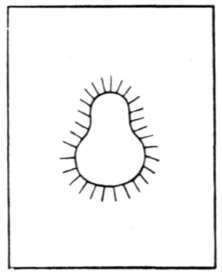
Fig. 52.
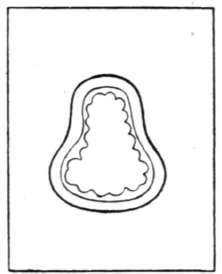
Fig. 53.
Toning
When the print is finally taken from the printing frame it must be placed (under pressure if possible) in a place secure from light and moisture to await toning, which process is sometimes delayed for weeks to suit convenience. This practice is a bad one as, however carefully protected from light and air, the whites have a tendency to deteriorate. The toning process consists in adding a thin layer of gold or platinum to the image, improving its chance of permanence and also its colour, which would otherwise be most disagreeable after fixing.
The components of chloride emulsions are not always the same in the different brands of P.O.P., and the directions supplied by the makers should be carefully followed. Some varieties must be placed directly in the toning bath, without any preliminary washing, or the loss of colour will be enormous. Other kinds must be washed for ten minutes before toning. Nearly all are improved by immersion for five minutes in a solution of common salt to transform the free silver salts. Some use a little carbonate of soda to destroy the acidity of the paper.
Gold Toning
The toning bath will consist of chloride of gold, with some compound to prevent the chlorine from reducing the silver image while the gold is depositing. Two grains of gold will tone a full-sized sheet, 24 1/2 x 17 in., and it is well to place prints in regular batches in the bath with a certain quantity of solution in order to obviate the irregular action of baths of varying strength. A too strong bath tones very quickly, but the prints lose terribly while fixing; a weak bath is too slow, and produces poor, dull pictures.
Acetate Bath. Stock Solution
Sodium Acetate. . . . . . . 1 oz.
Gold Chloride........ 15 gr.
Water........ 4 oz.
Mix 24 hours before it will be required for use. To tone half a sheet of paper, take 2 dr. of stock solution to 10 oz. of water. A reddish brown colour is reached in about 10 minutes. This is a very economical bath, giving a good brown to blue-black colour in the finished print.
Sulpho-Cyanide Bath
Gold Chloride . . . . . . . 2 gr.
Ammonium Sulpho-cyanide..... 24 ,,
Water......... 16 oz.
Mix separately in boiling water, and then add the two solutions together. This bath takes 12 hours to ripen. Some papers will not tone well in the sulpho-cyanide bath; others do better if the proportion of sulpho-cyanide is reduced by about one-half. The directions of the manufacturer should be consulted on this point.
Phosphate Bath (Kentmere)
Gold Chloride........2 gr.
Sodium Phosphate.......60 „
Water.........20 oz.
Formate (Wellington)
Gold Chloride........2 gr.
Sodium Formate . . . . . . . 60 „
Water.........40 oz.
The two last mentioned should be made up an hour before using. They will not keep.
Borax Bath
Gold Chloride........ 2 gr.
Carbonate of Soda....... 2 „
Borax . . . . . . . . . 60 „
Water . . ....... 16 oz.
The borax must be dissolved first in hot water with the carbonate, and the gold added on cooling.
Chloride of gold frequently contains free acid, and should be neutralised with a very little chalk or magnesium carbonate.
Subject to what has been remarked above with regard to the special characteristics of some emulsions, the sulpho-cyanide bath gives the most pleasing colour; tungstate, formate, and phosphate being likely to produce a cold blue-black after prolonged immersion. The toning bath does not work well when warm, and the best tones are usually found in cold weather. Keep the prints continually moving, and do not let the bath get too poor in gold, or the prints may turn yellow in the high lights, and may also give "double tones." As each print reaches its proper tone transfer it to a dish of clean water, replacing it with an untoned one. Five or six prints are enough for the toning bath at any one time.
Platinum Toning
Before toning the print must be soaked for five minutes in a solution of common salt, in order to free it from silver nitrate, washed, and then transferred to one of the following toning baths :
(1) Potassium Chloroplatinite . . . . . 2 gr.
Phosphoric Acid (sp. gr. 1.120)..... 40 min.
Water ......... 8 oz.
(2) Potassium Chloroplatinite...... 2 gr.
Sodium Chloride (common salt) . . . . 10 ,,
Citric Acid......... 20 „
Water......... 10 oz.
The first bath will give nearly black tones, but the pure blacks of a platinotype paper must not be expected. Platinum toning gives a greater chance of permanence, and, on the whole, better colours than gold toning, especially upon Matt surface papers. The weaker the acid in the bath the lighter the tones, and by varying the amount of acid (citric acid from 2 gr. to 25 gr.) a long range of tints, from sepia to pure black, are obtainable. Before placing in the fixing bath the acidity must be neutralised by immersing the print in a solution of carbonate of soda, 1 oz. to the pint.
To Stop Toning
If toning proceeds too rapidly the action of a gold toning bath may be stopped by dipping the print in a weak solution of sulphite of soda; the carbonate of soda solution at once arrests platinum toning.
Continue to:


My Books

