


Diaphragm, Improved Perspective Rendering By Telephotographic Lens. Part 7
Description
This section is from the book "Telephotography: An Elementary Treatise On The Construction And Application Of The Telephotographic Lens", by Thomas Rudolphus Dallmeyer. Also available from Amazon: Telephotography and Telephotographic Lens.
Diaphragm, Improved Perspective Rendering By Telephotographic Lens. Part 7
= 100af + f........(22) or 100 times the effective aperture multiplied by the focal length 4- the focal length of the lens ; or
= 100 If2 +f .......(22a)
When we focus upon a near object the front depth
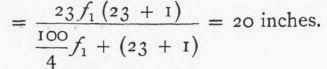
= nf(n + 1)____ ; 100 a + (n + 1) or n times the distance of the object ; 100 times the aperture + (n + 1) or
= nf(n+ I) ___ .........(23)
100 If+ (n + 1)
The back depth
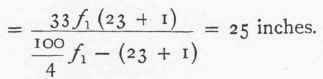
= nf(n + I) 100 a - (n + 1) or n times the distance of the object 100 times the aperture - (n + 1) or nf(n + I) .........(24).
100If - (n + 1)
Example. - An object is placed at a distance of 20 ft. from a Tele-photographic lens composed of a positive lens f1 of 10 inches focal length, working at an intensity I=1/4, and a negative lens f2 of 5 inches focal length; the primary image being magnified 4 times, or m=4.
In order that the primary image shall not include circles of indistinctness greater than 1/100 we find, as 1/n = 1/23.
Front depth
Back depth
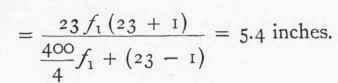
Now, if we place the focusing screen at a distance of 15 inches from the negative lens, we shall obtain a magnification of four times. Should the result be regarded from the pictorial point of view, it will not be necessary to pay attention to the fact that we have magnified the primary image, for the reasons stated above.
But if we do not wish the limit of indistinctness to exceed 1/100" in the final image, then the front depth
Back depth
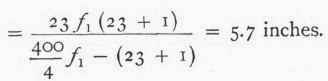
It will be observed that our process is to ascribe a smaller limit of indistinctness to the image produced by the positive lens proportionate to the amount it will be subsequently magnified.
We will now prove that of two lenses of the same focal length, one being of ordinary construction and the other of Telephotographic construction, that the latter has the greater depth of focus.
Example. - Let the focal length of both lenses be 30 inches, the Telephotographic combination being formed of a positive lens (c. de v. for instance) of 6 inches focal length and a negative lens of 3 inches focal length. Let both have the same effective aperture of 2 inches, or I in each case be 1/5. To find front and back depths for a "magnification " of 1/4, or n=4
(1) For the ordinary lens :
Distance of object
= 150 inches.
Distance of image
= 30 + 7 1/2 = 37 1/2 inches. Front depth
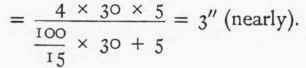
Back depth

(2) For Telephotographic lens :
Distance of object
= 186 inches.
Distance of image
= 12 + 7 1/2 = 19 1/2 inches.
(12 inches extension are required to make the 6-inch positive lens equivalent to 30 inches focal length, by means of the 3-inch negative; the increased conjugate 7 1/2 inches is the same as in the case of the lens of ordinary construction.)
Here n=186/6 - 1 =30 ; and for m = 7 1/2, 1/100 becomes 1/750, and 1=1/3
Front depth
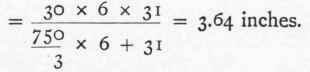
Back depth
= 30 x 6 x 31 = 3.8 inches
750/3 x 6-31
The following tables apply to measurements based upon an admissible circle of indistinctness of 1/100" in theimage formed by the positive lens alone. For this degree of definition in the final image the distances given in the first table must be multiplied by the magnification given to the image.
Table I. Table Of Distances At And Beyond Which All Objects Are In Focus And Maybe Considered As Situated In One Plane
Focal length of lens in inches. | * Intensities of Diaphragm Apertures. | |||||||||||||
f | F | F | F | F | F | F | F | F | F | F | F | F | F | |
4 | 56 | 6 | 7 | 8 | 10 | II | 15 | 16 | 20 | 22 | 32 | 44 | 64 | |
Number of feet distant after which all is in focus. | ||||||||||||||
4 | 33 | 24 | 22 | 19 | 17 | 13 | 12 | 9 | 8 | 7 | 6 | 4 | 3 | 2 |
4i | 38 | 27 | 25 | 21 | 19 | 15 | 14 | 10 | 10 | 8 | 7 | 5 | 31/2 | 2 1/2 |
4 1/2 | 42 | 30 | 28 | 24 | 21 | 17 | 15 | 11 | 11 | 8 1/2 | 74 | 51 | 4 | 3 |
43/4 | 47 | 34 | 31 | 27 | 24 | 19 | 17 | 12 | 12 | 9 1/2 | 84 | 6 | 5 | 3 |
5 | 52 | 36 | 35 | 33 | 26 | 21 | 19 | 14 | 13 | 10 1/2 | 91 | 61/2 | 51 | 3l |
5i | 57 | 40 | 38 | 33 | 28 | 23 | 21 | 15 | 14 | 1 1/2 | 101/2 | 7 | 51 | 31 |
5i | 63 | 45 | 43 | 36 | 31 | 25 | 23 | 17 | 15 | I2 1/2 | 111/2 | 71/2 | 6 | 4 |
5 3/4 | 68 | 50 | 46 | 38 | 34 | 27 | 25 | 18 | 17 | 13 1/2 | 13 | 84 | 61 | 4 |
6 | 75 | 54 | 50 | 42 | 38 | 30 | 28 | 20 | 19 | 15 | 14 | 9 | 7 | 4l |
61 | 81 | 58 | 54 | 46 | 40 | 32 | 29 | 22 | 20 | 16 | 15 | 10 | 71 | 5 |
6 1/2 | 87 | 62 | 58 | 50 | 44 | 35 | 32 | 23 | 22 | 17 1/2 | 16 | 11 | 8 | 5i |
6 3/4 | 94 | 67 | 63 | 54 | 47 | 38 | 34 | 25 | 24 | 19 | 17 | 12 | 81/2 | 6 |
7 | IOI | 72 | 68 | 58 | 51 | 40 | 37 | 27 | 25 | 20 | 18 | 124 | 9 | 6 |
7i | 109 | 78 | 73 | 62 | 54 | 44 | 39 | 29 | 27 | 22 | 20 | 131/2 | 10 | 61 |
7i | 117 | 83 | 78 | 64 | 58 | 47 | 42 | 31 | 29 | 24 | 21 | 141/2 | 101/2 | 7 |
73/4 | 124 | 90 | 83 | 71 | 62 | 5o | 45 | 33 | 31 | 25 | 22 | 151/2 | 11 | 7l |
8 | 132 | 96 | 88 | 76 | 68 | 52 | 48 | 36 | 32 | 28 | 24 | 16 | 12 | 8 |
8 1/4 | 141 | 100 | 94 | 80 | 71 | 56 | 51 | 37 | 35 | 29 | 25 | 171/2 | 1212/ | 8 1/2 |
8 1/2 | 150 | 104 | ICO | 84 | 76 | 60 | 56 | 40 | 38 | 30 | 27 | 19 | I3l | 9 |
83/4 | 156 | 111 | 104 | 89 | 78 | 63 | 57 | 42 | 39 | 32 | 29 | 20 | 14 | 10 |
9 | 168 | 120 | 112 | 96 | 84 | 67 | 61 | 45 | 42 | 34 | 31 | 21 | 15 | 10 1/2 |
9i | 180 | 127 | 116 | IOI | 90 | 71 | 65 | 47 | 45 | 35 | 32 | 22 | 16 | 11 |
94 | 190 | 133 | 125 | 107 | 95 | 74 | 68 | 50 | 47 | 37 | 34 | 24 | 17 | 12 |
93/4 | 197 | 141 | 131 | "3 | 99 | 79 | 72 | 52 | 50 | 39 | 36 | 25 | 18 | 12 1/2 |
IO | 208 | 148 | 140 | 120 | 104 | 83 | 75 | 55 | 52 | 42 | 3S | 26 | 19 | 13 |
* Intensities marked white on black ground are illustrated in Fig. 48.
In the annexed table the front and back depth must be divided by the magnification given to the positive lens, if the same degree of definition is required in the final image.
As the Telephotographic lens may be used with advantage in the production of direct enlarged images of objects which are situated approximately (or entirely) in one plane, we have included quite small multiples of the focal lengths of the positive lenses in the above table. These of course correspond to distances which are far too small for rendering good perspective, or the pictorial representation of objects lying in different planes.
The application of Table I. is obvious.
The application of Table II. is as follows: First select the standpoint from which the amount of subject to be included upon the plate appears in good perspective to the eye. Suppose the distance between lens and subject, in a particular case, to be 10 ft. Now the focal length of the positive element of the Telephotographic lens determines the scale of the primary image at this particular distance, and its intensity controls the front and back depth. Say the positive element is a "Cabinet lens" of 12 inches focal length; the scale is then 1/9, or 18 inches in the length of the subject will occupy 2 inches in the primary image. Beneath the column "10 feet" in the table, and opposite the lens of 12 inches focal length, we find both the scale of reproduction and the front and back depth for a limit of indistinctness of 1/100 of an inch. We must regulate the intensity by the amount of depth required. Say this is 10 inches; we find that at an intensity of f/6, that the combined front and back depth is rather more than this. Hence at a distance of 10 ft. the positive element of our combination, which has a focal length of 12 inches, gives an image 1/9 the size of the object and that a diaphragm of intensity f/6 must be used for the required definition throughout the image.
Continue to:


My Books

