


How To Play Table Tennis. Continued
Description
This section is from the book "Boy's Fun Book Of Things To Make And Do", by Grosset & Dunlap Publishers. Also see: The Pocket Dangerous Book for Boys: Things to Do.
How To Play Table Tennis. Continued
Stokes
Here are three ways you can stroke the ball to give it spin and make it go where your opponent won't expect it. A chop stroke, with a downward motion of the bot, imports a backspin, making the ball rotate against its direction of flight. For a topspin, the ball is stroked on top with the underside of the bat, making it roll forward as shown. The side spin, produced by a sideways motion of the bat, causes the ball to rotate in a horizontal plane, and to curve in its flight push, or block shot. Bring the bat in front of the body about waist high, using the reverse or backhand side of the bat only.
After the ball bounces, meet it with a gentle forward push, lifting the bat slightly to make the ball clear the net, and carrying the arm forward. These two movements are executed as one. If the ball doesn't clear the net, tilt the top of the bat backward slightly. Soon you will be able to control direction somewhat and to keep the ball low. When you get the feel of it, begin trying to angle your shots.
The stroke you have now learned is a defensive shot. Now you may take up the forehand drive, the attacking shot.
For this, stand two or three feet back of the table. The stroke is made with a forward and upward motion of the arm, full but not so sweeping as the tennis stroke. You want to apply top, or overspin, which raises the ball over the net in an arc and makes it dip swiftly to the table. At the moment of making the stroke, turn your body to the right (to the left if you are left-handed) to bring your left shoulder toward the net. Hit the ball at the highest point of its bounce and turn the body into it. The weight shifts from rear foot to forward but rear lights illuminate the half of the ball the player needs to see. Three or four shaded 100-watt bulbs do nicely.
With some sort of playing surface arranged, you can begin to learn the game. First time out you are going to be awkward, but don't mind that. Coordination and timing will soon come to you.
A good grip is of great importance. Practically all the best players agree that the so-called tennis grip is best. Freakish grips are frowned upon and you are advised to avoid, as if it were the plague, the old-fashioned penholder grip. Both of these grips are illustrated. Study them.
The strokes of the game are many, but you need be concerned at first with only four -forehand, backhand, serve, and half-volley. You can quickly gain sufficient mastery over these to play a spirited game against someone not too good.
Stand a foot or so behind the middle of the table, your weight on both feet, facing the net, the bat held firmly but not tightly. First you are going to make the half-volley.
Service
For the serve, the ball is held in the palm of the hand as illustrated below. Rules now forbid the old trick of holding the ball in the fingers and giving it a spin before striking it with the bat one, which is slightly advanced. Don't reach for the ball. Make your feet place you in position. Practice by hitting the ball gently back and forth. Do not try for speed or direction until you have reasonable certainty of execution.
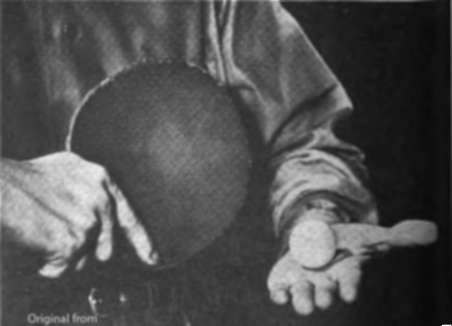
For the serve, the ball is dropped by hand Into the air and struck with the bat so that it first touches your court and then, passing over the net, touches your opponent's court. It is difficult at first, but an adequate, if not a good serve, is soon developed. The beginner tends to serve a ball that bounces too high, but speed will come with practice.
With forehand, serve, and half-volley you can begin to play actual games with another beginner, having first learned the rules. But you should begin at the same time to master the backhand. Try to get some sort of backhand at once.
The backhand is the forehand in reverse but it is more difficult because less natural. It is a shorter stroke and the ball is hit earlier after it bounces, usually while it is rising. The stroke is forward and upward like the forehand but with more wrist action. It helps if you shift the thumb up the blade a bit for the backhand.
There are other strokes without which no player can hope to go far but they are for
Rescue
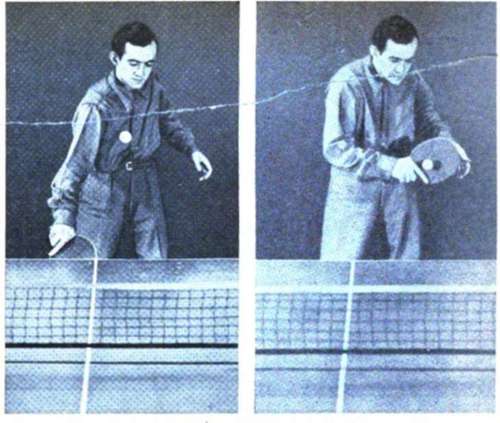
The rescue shot is a block shot executed at some distance back from the table. Like other defensive shots, it is made with the racket in the backhand position. Footwork is important to bring the player into just the right place for the bat to meet the ball at the right point, while still rising toward the high point of its bounce. A gentle push returns the ball across the net the future. The idea now is to begin playing and have fun right away. You have the basic strokes of the game and can play exciting games on your own level.
Later you will acquire the forehand and backhand chop, the backhand flick, the drop shot, and the smash. Do not worry about them now. If you practice well and begin to play games you will find yourself working into the other strokes. As you play you will see their possibilities and begin to exploit them. But do not take up any new stroke until the old one has been learned.
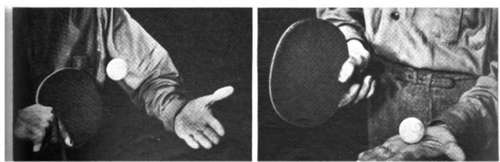
By moving the hand quickly away, the ball is dropped and struck almost instantly with the racket. It must touch the server's court, pass o'ver the net, and then touch the opponent's court. The serve shown in the pictures below and at the left is made in backhand position
The forehand serve is made in the same way, except that the racket is brought back in the forehand position. A beginner tends to serve a ball that bounces too high and gives an alert opponent an easy chance for a smash.
Continue to:


My Books

