


Rules For Four Games. Continued
Description
This section is from the book "Boy's Fun Book Of Things To Make And Do", by Grosset & Dunlap Publishers. Also see: The Pocket Dangerous Book for Boys: Things to Do.
Rules For Four Games. Continued
It is essential that the edges of the sections of the court meet evenly. The playing surface must be smooth and uninterrupted. There should be no difficulty in this connection when the court is laid on a cement garage driveway or a paved terrace, or on any floor indoors; but if it is placed outdoors on uneven ground, the court should be supported by blocks where there are depressions, and the sidepieces must be securely bolted on to hold the sections even. It should be clearly understood that the side-pieces are accessories, to be used only when necessary, and that for some of the games they need not be used at all if the ground is even.
If toggle bolts are not obtainable-although most large hardware stores keep them in stock-you can use ordinary bolts with the heads cut off and with about an inch of the smooth shank bent at a right angle to form a sort of square hook. Bolts so bent will require larger holes than the toggle bolts, and large washers will have to be used under the nuts. A better method is to cut horizontal slots to accommodate them.
With the four sections and the ten sidepieces finished, the game equipment and other accessories can be made, and some of them, if preferred, can be bought.
The games for which this court was arranged are listed at the
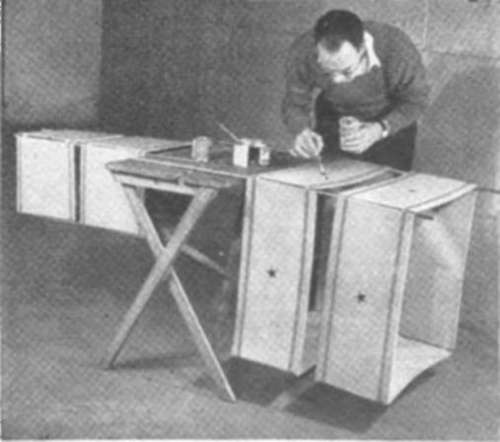
While the folding boies used in the game of bounce are being painted, they are suspended on metal curtain rods or other rods nailed across a worktable. This makes them convenient to handle left of the chart on a preceding page, and the equipment needed is shown along the top. Some items of equipment are used in more than one of the games, as shown by the check marks on the chart. Some of the games can be played with more than one kind of equipment. Thus tenpins, for example, can be played with balls or with cues and disks.
In addition to the equipment listed, a cloth bag for bolts, washers, nuts, and a monkey wrench is handy to have, as well as a slate or blackboard, an easel, chalk, and an eraser for scoring the games.
No set dimensions need be followed in making the equipment. The size of the various items can be governed, within limits, by the materials available.
Cues
Four or six of them may be made. The head is shaped as shown in the drawings, and the handle is 4' 6" long with a band painted around it. Each cue has a band of a different color to match the disks so that each player will know his own.
Disks
These are of hardwood, thick and 41/2" in diameter. Their edges are slightly rounded to facilitate sliding, and each disk has two circular depressions, one on each side. These are 2" m diameter and deep. The "floor" of each depression is painted, and this paint will not wear off because it is not subjected to friction when the disk slides.
Folding Boxes
There are four boxes for the game of bounce. The game is played with table-tennis balls and paddles. The boxes are four-sided; that is, without any top or bottom. The sides are hinged one to another with leather hinges cut from a school strap or any available piece of leather. The hinges permit the boxes to be folded flat. When set up for play, two of the boxes form 12" cubes and two of them are 10" high by 24" square.
Tennis-Table Balls And Paddles
These are purchased, although it is easy enough to make paddles, if desired.
Darts
Feathered darts can be obtained as a rule for about a dollar a dozen.
Bags Of Sand
Each bag is made of two circular pieces of strong cloth about 5" in diameter, sewed together around the edges except for a small gap for the insertion of a funnel. The bags are filled with sand or lead shot, and the gap is sewed closed. The bag is then slapped as flat as possible and kept flat by a few strong stitches through the center.
You will find the court adaptable also to tenpins, quoits and croquet.
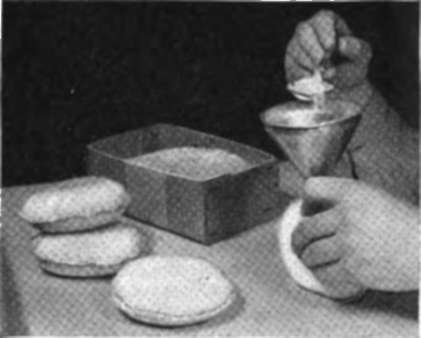
Sand it poured through a funnel into the circular bullboard bags. The gap is then closed, the bag flattened, and a few stitches taken in the center.
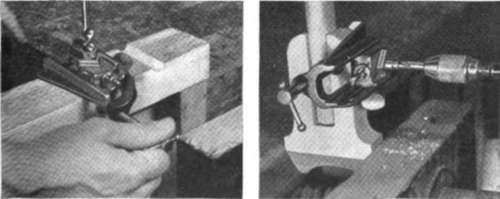
A doweling jig, if available, can be used in boring holes in the frames for the toggle bolts that hold •n the sidepieces. Note at right one of the half holes for the stakes required in quoits and croquet.
Boring one of the holes for the bolts that fasten the head of a shuffleboard cue to its handle. Because of the small diameter of the drill, a short piece of brass tubing is inserted in the jig as a bushing
Continue to:


My Books

