


Steps In Building Your Rope
Description
This section is from the book "Boy's Fun Book Of Things To Make And Do", by Grosset & Dunlap Publishers. Also see: The Pocket Dangerous Book for Boys: Things to Do.
Steps In Building Your Rope
Building Your Rope
Start with 25 feet of No. 12 spot cord, tightly woven cotton rope. You can buy it from any good western supply store

Trim the end at an angle so it will fit snugly against the other side when the bend is made. Rope is 3/8 inch thick, costs 71/2 to 12 cents a foot.
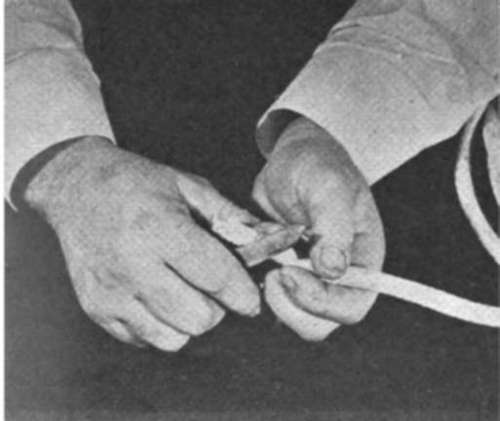

The end of the rope is now doubled back about 21/2 inches to form a natural loop, and an awl is forced through it to make a hole for threading.

Draw a heavy waxed harness thread (or a light copper wire) through the hole and wrap tightly around the beveled end to form the honda, or loop.
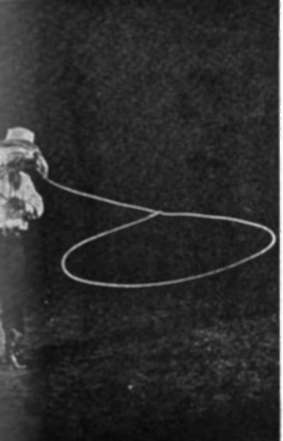


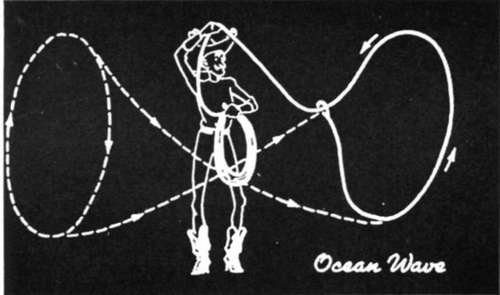
The "Ocean Wave" shown pictures. See diagrammatic instructions on page 44.
HONDAS on maguey ropes are delicately made, with braided joints and rawhide swivels. A rawhide balance is also put on the tip of the loop and made rough with a knife so the rope won't slip too fast
Holding The Rope
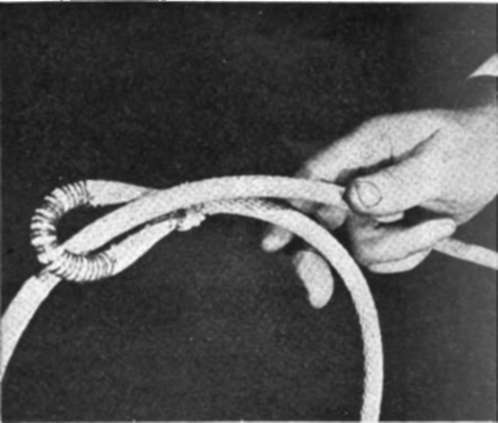
For spinning, the loop is held by the first and second fingers, and the spoke (the length that passes through the honda to the hand) by the thumb and two remaining fingers. In the photograph, the spoke is shortened to illustrate the holding position, but in actual spinning it must always be one third of the length of the loop. This finger arrangement makes it easy to drop the loop after it has once been put into motion.

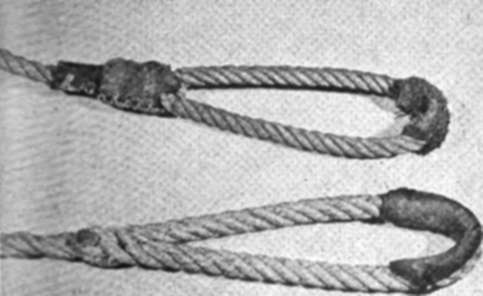
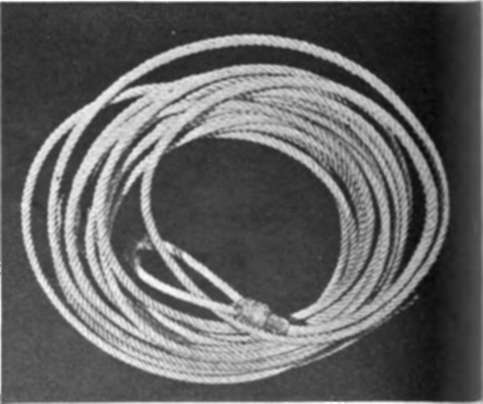
A STEEL GROMMET in the honda at top gives extra weight. Lower honda has wire wrapped around its tip. Some kind of wrapping is necessary in all hondas to give balance and to spread out the bend.
MAGUEY ROPE ( pronouncedmagay) made from the Mexican maguey plant is used by professionals for fancy horse roping. Made under water, they become stiff as steel cables and require expert handling.
When you have made your rope ready, next make a noose. The spoke--the length of the rope that passes through the honda to the hand-is the part you hold when you cast your loop, and must be one third of the loop you intend to cast. Note carefully the finger position. The loop is held by the first and second fingers while the thumb and two remaining fingers remain on the spoke.
As the loop widens in spinning, the spoke slips gradually, taking up the free rope. As there is no swivel on this lariat, the rope must turn in the hand, and when the end of the free rope is reached it must not be held tightly in the hand, or it will start to wabble, curl, and kink. To help yourself along, wrap the end of the rope with smooth wire or waxed string to form a ball so that it will turn easily in your hand when all the rope but the spoke is out in the spinning loop.
Patience is required now. Make a ringlike movement of the rope as if trying to spread it on the ground in front of you. Don't jerk it. Don't fling it. Too much speed is the fault of every beginner. You may not make it the first time. The rope will probably come flapping back against your legs. Making certain all the kinks are out of the rope, start with the thought that you are about to swing the loop around a low tub in front of you. As you swing, you let go the loop. The right hand, still holding the spoke, of course, follows the loop around and around. Don't try to keep it circling as wide as the loop; You will find after a few attempts that it is a rotary motion of the wrist that keeps the rope going. Once the loop is established and in a spin, gradually increase the speed of the right hand to widen it. Because it is more natural for the right hand to swing counterclockwise, many people find it easier to start their first loops in that direction. Start the way you find your hand most supple.
Your next step is to get your loop large enough to step into it. Watch your spoke. See that the loop is spinning evenly. As the spoke comes to you, give your hand a slightly harder twirl. As the spoke passes your feet, step into the loop with the right hand going up above your head to keep up the rotating movement of the wrist.
When you have gone this far you are on your way. Some of the fear of the loop is gone. You are not afraid it is going haywire each time you swing a loop in front of you.
You are at a point now where you can begin to overcome the twisting of the rope and the kinks that come with it. Learn to play small loops back and forth in front of you. Say, for instance, a swing of the small loop to the left to where it goes up and almost stops. As it comes back reverse the spin. This takes away the twist and starts it in the other direction.
Once you have caught and mastered one of those tricks others come to you. You are now working in sequence, and you are on your way to some of the more spectacular
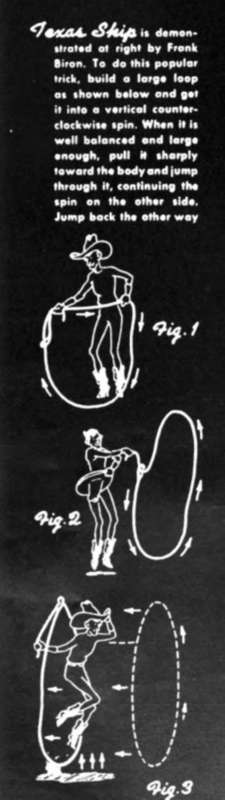
The noose is carried upward in front of the body- it is not to be jerked, but should be eased gradually into position seen
When slightly above the head, it is thrown up and then down around the body. Timing and balance must be perfect or the trick is ruined

Ocean Wave
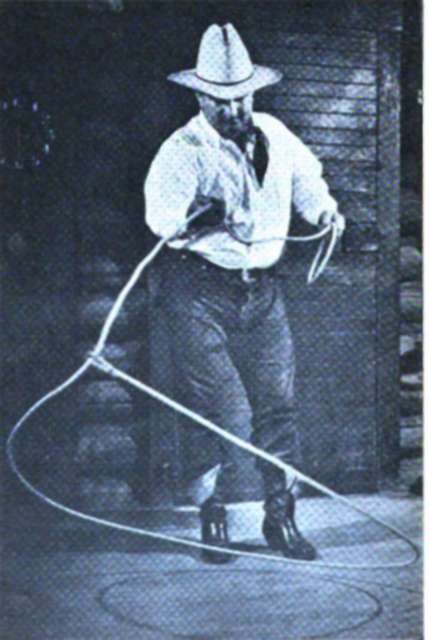
Hero you carry a large loop around the body in a vertical position, using a figure-eight motion. The constant dipping gives this trick the characteristic wavy effect from which it gets its name stunts shown on these pages.
Continue to:


My Books

