


2. Crawlers And Toddlers
Description
This section is from the book "How To Build Games And Toys", by B. W. Pelton. Also available from Amazon: How To Build Games And Toys.
2. Crawlers And Toddlers
During the latter part of the creeping and crawling stage, young children begin to concentrate their efforts upon hoisting themselves to an erect position in imitation of their elders. Their early frustrations can be mitigated somewhat, by providing them with reliable playthings to help them forget their repeated failures, with attendant bumps.
In general, child psychologists advise that pre-walkie-talkie infants are basically interested in push, pull, or pile-up-and-knock-down playthings, until they become two and one-half years old. Sometime during the period between one and one-half and three and one-half years of age, we are told that an interest in toys and games of accomplishment will develop.
Obviously, therefore, simple toys stressing muscular coordination are highly desirable during this phase of development. If some of these playthings are of a type to render assistance in the precarious business of balancing on two feet, so much the better.
Spool Board
For the crawler, a simple "learning" toy can be assembled from six spools, a length of dowel rod, and a scrap of lumber. The spools, of course, should be of equal size, as in Figure 2.4.
Cut a piece of 3/4-in. stock into a base 4 in. wide by 6 in. long, and round and sand the corners. Assuming that the spools are 1 1/4 in. long and will rotate freely on pieces of 1/4-in. dowel, cut the latter into 2-in. lengths and bore six holes $ in. deep on 2-in. centers, as indicated in the drawing. Chamfer each dowel at both ends by whittling and sanding, or sanding against a wheel, and glue them upright in the centers of the six squares, as shown in the drawing. If the toy is to be used in the bath, use waterproof glue.
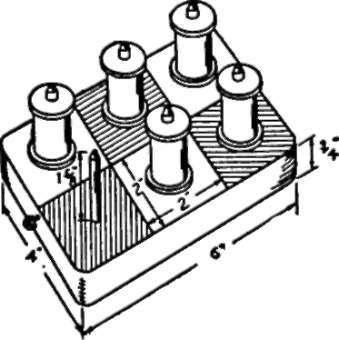
Fig. 3.4. Spool board.
Before gluing the dowels into place it is a good idea to mark off the squares with a dull knife, an awl, or a sharp nail, in order to keep the paints from differently colored squares from overrunning. Insert a screweye in front edge for a pull string.
The six squares, their pegs, and the spools are then enameled with the six colors—red, orange, yellow, green, blue, and violet. Due care must be taken not to clog the holes in the spools or thicken the pegs unduly with pigment.
Continue to:


My Books

