


Memocolor
Description
This section is from the book "How To Build Games And Toys", by B. W. Pelton. Also available from Amazon: How To Build Games And Toys.
Memocolor
From Maastricht, Holland, comes a simple, pocket-sized game called Memocolor. As its name implies, the successful players are those who are able to memorize the orders or successions in which the bands of color appear on each of the six little sticks, as indicated in Figure 5.21. After each play, the selected stick is returned to its masking hole, topside up.
In the original game the sticks were 2-in. lengths of 1/4-in. dowels, inserted loosely into six 5/16-in. holes drilled 15/8 in. deep in a masking block of 1/2- or f-in. wood, 23/4 in. long by 13/4 in. high. The dice were marked on 1/2-in. wooden cubes, with the colors painted in circles, which could have been stamped from empty 22 cal. cartridge cases. If a pair of dice is available, it is easy to paint, enamel, or crayon one of the six primary colors over each of the faces of one of the pair. The bands of color, about 3/16 in. wide, can be put on with a striping brush or an artist's pencil brush. When only one brush is available, bands of the same color of quick-drying enamel or lacquer can be applied at the proper positions on the sticks. While these are drying, the brush can be cleaned by dipping it in its proper solvent and rubbing it back and forth over a piece of screenwire tacked over a small, empty box.
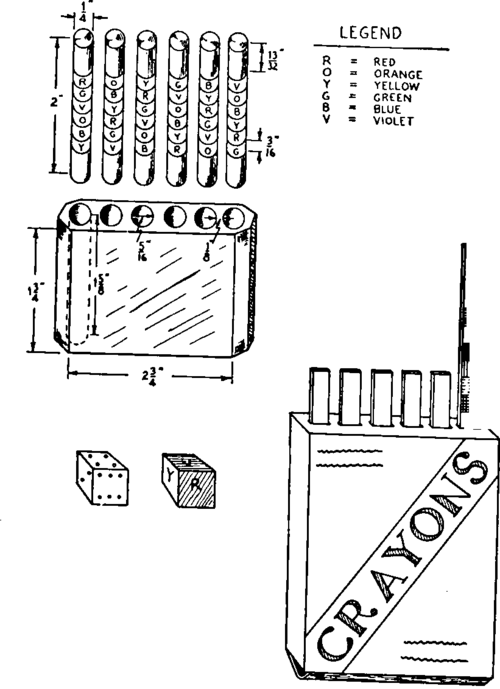
Fig. 5.21. Memocolor.
The game was mailed to the United States during the war, but the translations of the "Spelregels" or Rules of Play were mailed at a later date and failed to arrive. The writer is indebted to Jhr. Dr. E. V. E. Teixeira de Mattos, Consul in charge of the Consulate General of the Netherlands, for the translation which follows:
The game is played with a pair of dice; one indicates the color and the other the place of the color on the little sticks. If, for example, red and number three come out, the little stick which shows red as third color is the one to be drawn.
Before starting the game, the players have the opportunity to take note of the succession of colors on the little sticks. Each player pays two chips in the pot; the winning of the spot is subject to the following rules, which can be combined or applied separately to the game.
1. The one who draws ten times correctly is winner.
2. The one who among the correctly drawn colors has the six different colors, is winner.
3. The one who among the correctly drawn colors has at least six times the same color, is winner.
The play can also be played without a pot. Each time when a player draws wrongly, he has to pay a chip, while the player who draws correctly, wins the pot. In case this pot is empty, each of the other players has to pay one chip to the winner.
After each play the little chips are being shuffled and put away."
A Jiffy Game of Memocolor can be assembled from an empty chalk or crayon box with six slits cut in its bottom edge into which six narrow strips of stiff paper can be pushed. These paper strips are colored in bands with crayons or water color, and the faces of one of a pair of dice colored with crayon.
Continue to:


My Books

