


Planting Corn And Tunnel Ball
Description
This section is from the book "How To Build Games And Toys", by B. W. Pelton. Also available from Amazon: How To Build Games And Toys.
Planting Corn And Tunnel Ball
Planting Corn
An empty cardboard shoebox with holes the size of a quarter, cut and numbered as illustrated in A of Figure 6.10, represents the plowed field into which the youthful farmers endeavor to toss kernels of corn from a distance of six feet. Within the box three cardboard sections with the two shorter ones on a diagonal, will isolate the lucky kernels under their respective holes so that the score can be added up when the lid is removed. If the kernels have been dipped in different colored inks or paints so that each player can have a color, the box lid need only be removed after all have thrown. Each player may then toss five, ten, fifteen, or less kernels.
Tunnel Ball
Another shoebox target, this time for rolling, is pictured in B of the drawing. The center arch is not much wider nor taller than the ball used for rolling through it, and therefore counts 5 points, as against 1 and 2 for the larger arches. The one who gets 11 points first is the winner.
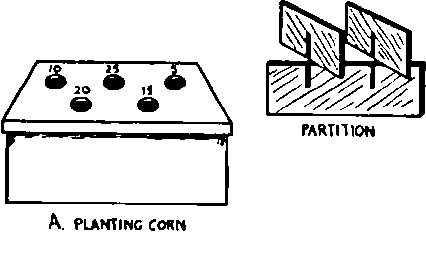
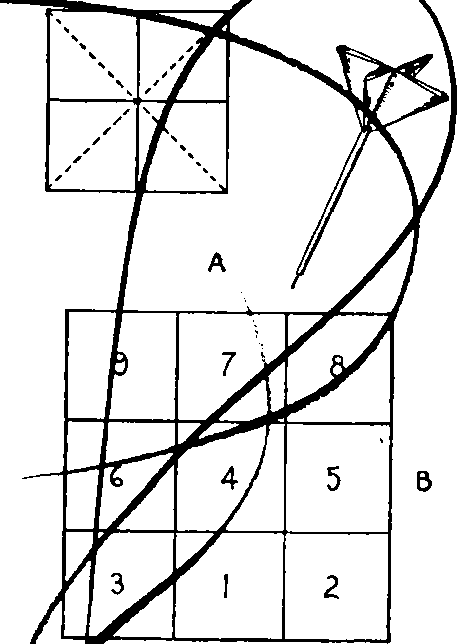
Fig. 6.10. Shoebox targets.
A variation is to place the tunnel box at the end of a smooth ironing board, elevate the opposite end on books, and let the ball roll down by gravity.
Bottle Bowling
Provided a rubber ball is used for bowling, empty Coca-Cola bottles will prove ideal substitutes for miniature tenpins. Although their sturdy thickness renders them exceptionally shatterproof, the anxious parent can insure them against fracture and deaden the sound of their downfall by wrapping them with adhesive tape. This will provide an easier surface to enamel in bright colors at some later date, if desired.
When the bottles are spotted over chalk marks on a hardwood or linoleum surfaced floor, a soft ball (baseball) can be propelled with sufficient vigor to bowl a strike. The number of pins can be reduced to five, in the form of a reversed wedge, or to six, with the base of the wedge filled in. Indeed, for the very young, three bottles often present an acceptable target when the balk line is chalked six or eight feet from the pins.
As both interest and dexterity increase, there may come a time when it will prove feasible to place the base of the fivepin or tenpin triangle sufficiently in advance of the rear wall so that scores will only be counted on a rebound from the rear. Similarly, penalties can be assessed for direct hits from the front, prior to a rebound from the rear wall.
Continue to:


My Books

