


XII. General Principles. Part 2
Description
This section is from the book "Geometric Exercises In Paper Folding", by Tandalam Sundara Row . Also available from Amazon: T. Sundara Row's Geometric Exercises in Paper Folding (Large Print Edition).
XII. General Principles. Part 2

Fig. 54.
162. Parallelograms have a center of symmetry. A quadrilateral of the form of a kite, or a trapezium with two opposite sides equal and equally inclined to either of the remaining sides, has an axis of symmetry.
163. The position of a point in a plane is also determined by its distance from a fixed point and the inclination of the line joining the two points to a fixed line drawn through the fixed point.
If OA be the fixed line and P the given point, the length OP and A OP, determine the position of P.

Fig. 55.
O is called the pole, OA the prime-vector, OP the radius vector, and A OP the vectorial angle. OP and
 A OP are called polar co-ordinates of P.
164. The image of a figure symmetric to the axis OA may be obtained by folding through the axis OA. The radii vectores of corresponding points are equally inclined to the axis.
165. Let ABC be a triangle. Produce the sides CA, AB, BC to D, E, F respectively. Suppose a person to stand at A with face towards D and then to proceed from A to B, B to C, and C to A. Then he successively describes the angles DAB, BBC, BCD. Having come to his original position A, he has completed a perigon, i. e., four right angles. We may therefore infer that the three exterior angles are together equal to four right angles.

Fig. 56.
The same inference applies to any convex polygon.
161. Suppose the man to stand at A with his face towards C, then to turn in the direction of AB and proceed along AB, BC, and CA.
In this case, the man completes a straight angle, i. e., two right angles. He successively turns through the angles CAB, EBC, and BCA. Therefore EBB +
EBB + BCA +
BCA + CAB (neg. angle) = a straight angle.
This property is made use of in turning engines on the railway. An engine standing upon DA with its head towards A is driven on to CF, with its head towards F. The motion is then reversed and it goes backwards to EB. Then it moves forward along BA on to AD. The engine has successively described the angles ACB, CBA, and BAC Therefore the three interior angles of a triangle are together equal to two right angles.
167. The property that the three interior angles of a triangle are together equal to two right angles is illustrated as follows by paper folding.
Fold CC perpendicular to AB. Bisect C'B in N, and AC in M. Fold NA', MB' perpendicular to AB, meeting BC and AC in A' and B'. Draw A'C, B'C.

Fig. 57.
By folding the corners on NA', MB' and A'B', we find that the angles A, B, C of the triangle are equal to the angles B'C A, BCA', and A'C'B' respectively, which together make up two right angles.
168. Take any line ABC. Draw perpendiculars to ABC at the points A, B, and C. Take points D, E, F in the respective perpendiculars equidistant from their feet. Then it is easily seen by superposition and proved by equal triangles that DE is equal to AB and perpendicular to AD and BE, and that EE'\s equal to BC and perpendicular to BE and CF. Now AB (=DE) is the shortest distance between the lines AD and BE, and it is constant. Therefore AD and BE can never meet, i. e., they are parallel. Hence lines which are perpendicular to the same line are parallel.

Fig. 58.
The two angles BAD and EBA are together equal to two right angles. If we suppose the lines AD and BE to move inwards about A and B, they will meet and the interior angles will be less than two right angles. They will not meet if produced backwards. This is embodied in the much abused twelfth postulate of Euclid's Elements.*
169. If AGH be any line cutting BE in G and CF in H, then
* For historical sketch see Beman and Smith's translation of Fink's History of Mathetnatics, p. 270.
 GAD = the alternate
 AGB, '.' each is the complement of
 BAG; and
 HGE = the interior and opposite
 GAD. ... they are each =
 AGB. Also the two angles GAD and EGA are together equal to two right angles.
170. Take a line AX and mark off on it, from A, equal segments AB, BC, CD, DE... .Erect perpendiculars to AE at B, C, D, E.. .. Let a line AF' cut the perpendiculars in B', C', D', E'.. .. Then AB', B'C, CD', D'E'.. .. are all equal.
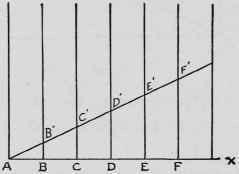
Fig. 59.
If AB, BC, CD, DE be unequal, then AB:BC=AB':B'C BC: CD = B'C: C'D', and so on.
171. If ABCDE.... be a polygon, similar polygons may be obtained as follows.
Take any point 0 within the polygon, and draw OA, OB, OC,....
Take any point A' in OA and draw A'B', B'C, CD'.... parallel to AB, BC, CD-----respectively.
Then the polygon A'B'C'D'. . .. will be similar to A BCD.. .. The polygons so described around a common point are in perspective. The point O may also lie outside the polygon. It is called the center of perspective.
172. To divide a given line into 2, 3, 4, 5.. . .equal parts. Let AB be the given line. Draw AC, BD at right angles to AB on opposite sides and make AC=BD. Draw CD cutting AB in P2. Then AP2 = P2B.
Continue to:


My Books

