


Badminton
Description
This section is from the "The American Girl's Home Book of Work And Play" book, by Helen Campbell. Amazon: The American girl's home book of work and play.
Badminton
Badminton is a game suited either for indoor or outdoor recreation : it may be played in the hall, or on the grass-plot or lawn. The dimensions of the ground for outdoor play should be 60 feet long by 30 feet wide (the proportions of an ordinary billiard-hall); but the game is occasionally played on one 80 feet by 40 feet. Whatever size, however, the ground may be, the same relative proportions should be adhered to. The net sold with the implements is to be stretched across the hall or lawn (hanging vertically); and the cord, having been affixed at top and bottom to the standard, is to be secured to a stake or peg driven into the ground at each end of the net. (See plan.) The net divides the players into two sides; and each side should be further divided into two courts, shown respectively at A B and C D. In order to define the courts, a cord may be drawn through the centre of the net, or they may be marked out by means of chalk upon the turf. At three feet distance each side of the net a line is to drawn, and this is termed the serving-crease. The game may be played by any number of persons, not exceeding eight on each side; but four players on each side is the usual number.
The first side to serve is to be determined by lot; and, in order to equalize the chances, only half the number of
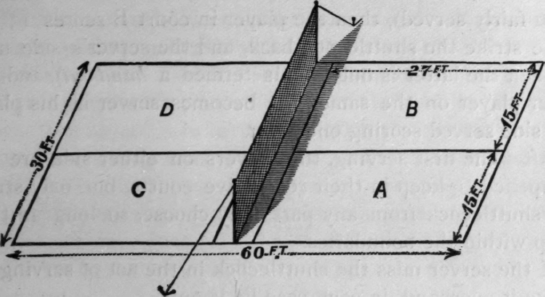
Fig. 47.
players on this side serve in the first innings. After the first innings, all the opponents serve, then all the others, and so on in rotation ; and the side which first scores 21 or 29 (according to the number playing) becomes the winner of the game. When the players do not exceed two or four on each side, the game consists of 21 points ; but, if more than four, 29.
The game is commenced by one of the players standing in one of the courts, say in B, and serving the shuttlecock to that player stationed in the opposite court diagonally to that in which the server is ; viz., in C. Serving the shuttlecock is an important feature in the game, and the rules in regard to it must be rigidly adhered to. It is performed thus : the player, termed the server, takes the shuttlecock in the left hand, and strikes it with the battledoor in his right over the net, and beyond the serving-crease on the other side; but, in serving the shuttlecock, the battledooi must never be raised higher than the elbow, and it must invariably be struck underhand. At other times it may be struck at either over or under, but only the latter when serving. If the adversary in court C, termed the servee, miss it (the shuttlecock having been fairly served), then the player in court B scores i; but if he strike the shuttlecock back, and the server's side miss it, then the latter is out (this is termed a hand-out), and another player on the same side becomes server in his place, the side served scoring one point.
After the first serving, the players on either side are not compelled to keep in their respective courts, but may strike the shuttlecock from any part they choose, so long as they keep within the boundaries.
If the server miss the shuttlecock in the act of serving, or strike it overhand, in each case he is out.
If the shuttlecock does not clear the net, or if it fall within the serving-crease on the other side, he is out; or if served into the wrong court, or beyond the bounds of the ground, he is likewise out.
When the server's side makes a point, Le., scores I, he (the server) must at once move into the court to the left of that in which he stands ; thus from court B he would move into A, or from C into D, according to the side in. Another server then takes his place, or, if all on one side have served, then the opponents in their turn become the servers.
The side serving makes a point if the shuttlecock is missed by the adversary, or if it is not struck back entirely clear of the net, or if struck beyond the bounds of the game.
A player is not compelled to accept the serving if the shuttlecock be served into the wrong court, or beyond the bounds of the ground; but if the player strikes at the shuttle cock, it counts.
The players change into the opposite court at the termination of each game, and the winners of the last game become first servers in the next.
Continue to:


My Books

