


Chapter III. Doll's Houses And Make-Believe Housekeeping
Description
This section is from the "The American Girl's Home Book of Work And Play" book, by Helen Campbell. Amazon: The American girl's home book of work and play.
Chapter III. Doll's Houses And Make-Believe Housekeeping
Dolls were once supposed to belong solely to little girls; but they are now so beautifully made, and so real, that to own a large one is next to playing with a live baby, and has a great advantage over that amusement, in that it will never cry, or rebel at being put away when the play ends. For any little girl who really loves dolls, there is not the slightest need of writing any of the thousand ways of playing with them. My dolls were just as much alive as I was ; and there were parties and weddings and christenings and funerals, just such as are part of all homes. Almost every child now has doll's bureaus and trunks, so that all the little clothes can be kept in perfect order; and to teach the dolls the best way of doing this will take a great deal of time. But it is with dolls as with people: unless they have houses of their own, it will be impossible to live in just the right fashion. And doll's houses are so easily made, and there can be such pleasure in furnishing them, that there is no excuse for not having at least one in every family. There is no occasion for buying an elaborate one at a great toy-store, or even spending money on the carpenter; for very good ones are made by simply using well-made packing-boxes ; those for books being-smoothest and nicest, but those in which canned goods are packed answering very well. Two of these boxes can be set one on another, each divided into two rooms by a thin board, or even pasteboard, fitted in. It is not hard to cut windows, which can have glass fastened inside; and the whole should be neatly papered inside and out before beginning to furnish. The book-boxes are usually three feet long, and a better shape than the can-boxes, which are too deep for the width. Choose a dark-gray or light-brown paper for the outside ; and by reading the directions for cardboard houses in Chap. V., Part III., you will get an idea of how to finish off about the windows, and can even imitate a roof and chimneys if you like.
For the first house, four rooms are quite enough; and, if you choose to begin with a small box and small dolls, almost all the furniture can be of stout cardboard. Remember that a big doll in a little house is as ridiculous as an old-fashioned giant would be in ours, and have every thing match and harmonize as nearly as you can, not only in size, but in colors. For instance, in the parlor do not have a red sofa, and a blue chair, and a green table-cover, but remember that crimson or dark red must have soft browns, or olive-greens, or even gray, with it; that blue in a bedroom may be combined with gray, pale pink, or garnet; and that green goes well with oak, or with gray. This is the way a tomato-can box I know about was furnished for very small dolls, - a father and mother, and one baby in a little cradle. Bessy had talked it over with her mother, and decided, that as the young couple were just beginning life, and had not much money, they ought to be willing to live in a very simple way; and so a small"flat"was just the thing. Bessy's father divided it for her into three rooms, and cut doors between ; or, rather, he marked the doors, and Bessy cut them out herself with a jig-saw, which she could handle very well. Windows were cut out, and a thin piece of mica fastened on with gimp-tacks ; and the sashes were made of pasteboard pasted on. Then the whole was papered outside with a light-gray paper, and left to dry. A roof had first been made by sawing the side of the box in two, and then nailing it on the top, gluing it together at the top, and fastening on a little chimney. This was all papered in dark red, like a Queen Anne roof. Inside there were three rooms, - parlor, bedroom, and the dining-room and kitchen in one. This troubled Bessy. But her mother said that a lady never made work as she went, as an ignorant woman always did, and that it was quite possible to have a kitchen-stove behind a screen, managed so that hardly anybody would know it was there.
Curtains were made first for all the windows, - two in the bedroom, three in the parlor, and two in the kitchen. Those for the parlor were of cheese-cloth, with broad hems, and a narrow lace sewed on. The rods, from which they hung by little brass curtain-rings, were very small lead-pencils, which looked like ebony, and rested in two little picture-screws, into which they ran easily. The bedroom had rods also; and the curtains, bedspread, and chair-covers were blue chintz with a small pink rosebud in them ; while the dining-room had cream-colored linen shades that were rolled up and tied. Between parlor and bedroom hung a portiere, also on lead-pencil rod, and made of deep-garnet merino. The parlor and bedroom floors were carpeted with thick garnet-and-blue stuff left from covering a chair; and the dining-room had a gray oilcloth, in imitation of little tiles, and a rug in the middle, made of dark-gray canton-flannel, with a deep-red border. With carpets and curtains, it began to look like a house; and then came the furnishing. For the parlor a toy-table had a red merino cover, matching the portiere, with a border of ribbon in gay Persian colors ; and a sofa was made by taking a small paper-box, six inches long, two wide, and one high, and, after laying cotton-wool thickly on the top, covering the whole with the friendly merino. Three pillows, each two inches square when finished, were also made, and the edges of all finished with very fine old-gold cord. The rocking-chair, and some reception-chairs, were all cut from cardboard diagrams given in Chap. 1, Part I. The bookcase, made from a paper-box, with pasteboard shelves fitted in, and the whole painted brown, was filled with the tiny volumes sold in sets at any agency of the American Sunday-school Union ; though even they were so large in proportion, that it was like having a library of big dictionaries. Two ottomans were made from very small pillboxes, stuffed with cotton, and covered with merino. The mantelpiece was a piece of pasteboard, fitting between the windows at the end, an inch and a half wide, and tacked against the wall, after being covered with the merino, and a very narrow fringe to match sewed on the edge. On it stood some tiny vases and ornaments. Four chairs and a rocking-chair were cut from cardboard, after the models given, and a toy-piano which stood in the corner, and which had been on the Christmas-tree as a present to the mamma-doll.
The parlor had a dark-red dado three inches high; above it just common brown wrapping-paper, finished with a half-inch border of dark red, and, where the dado joined the paper, a very narrow line of gilt. Bessy framed some pretty photographs, and one little water-color, - an Easter-card, - by having glass just the same size, and pasting narrow black ribbon around the edges; and she had enough for all the rooms. The bedroom was papered in pale blue, with gilt border; and the dining-room in gray and red.
The bedroom mantelpiece was covered with chintz like the curtains, and edged with a very fine plaiting of the same ; and that for the dining-room was in gray crash, with red worsted fringe. The bed, bureau, and chairs were at first cut from cardboard. But Bessy's success with sofa and ottomans had given her confidence; and she made a bed from a paper-box six inches long, four wide, and one high. The cover she took off, turned the box upside down, and sewed the cover to it, making a high back, as in diagram below, which was bent over, and cut in a half-circle to form a canopy like this. All this back was covered with the pink-and-blue chintz, and a plaiting of it set around the edge of the canopy. The mattress was made of cotton-cloth cut just the size of the bed, a piece half an inch wide set in all around it, and the whole stuffed with cotton, and tufted like any mattress. The sheets were cambric, nicely hemmed; the blankets, fine flannel, buttonhole-stitched in blue worsted ; and the spread of chintz. Square pillows and a bolster were made, and the sides of the box covered with chintz. The toilet-table was another box, four inches high and five broad. A little glass was hung at the back, and the whole draped with dotted muslin tied with narrow pink-and-blue ribbon. Two pill-boxes covered with chintz made ottomans; and there were a small bureau, and some little chairs made from high but small round boxes cut like a barrel-chair, as in the diagram below, and covered, also, with chintz.
For the dining-room, Bessy already had a little table and

Fig. 90. - Bed.

Fig. 91. - Canopy.
four chairs ; and these were in the centre of the room. A little pantry was made from a small cigar-box, fitted with shelves; and another little table had some shelves fastened to the back, and became a sideboard, filled with the metal teaset, and little glass tumblers and dishes; and behind the pretty screen, made from a toy clothes-horse covered with Christmas-cards, stood the little stove, and all the pots and pans hanging near it.
Here housekeeping went on every day, as carefully attended to as her mother's. The family went to bed, and got up. The little bedclothes were hung out to air ; the breakfast was got and cleared away; the baby had its bath, and took a nap; and then the parlor was dusted, and the bed made, and every thing put in order for the day. There were dinners and tea-parties; and little accounts were kept, and stores laid in, and all the round of daily work carefully gone through with. The baby grew up, and married: the father broke his leg. Every thing happened that could happen. And at last the house gave way,-first to a much larger one, with real carpets, and a hall and stairs, and furniture, some of which Bessy carved herself; and at last to a little room, where her mother had a little cook-stove like the one in"Little Men,"and where Bessy herself actually cooked from receipts given in a book called"Six Little Cooks."Her brothers cut the wood for it, and considered themselves paid by an invitation to tea; and, as she grew more and more skilful, older people were rather anxious to be invited too.
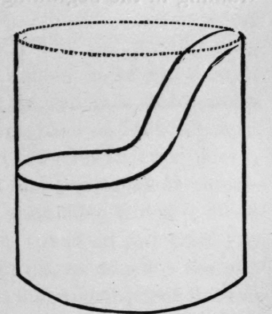
Fig 92. - Pill-box Chair.
Given a set of toys such as accompany Miss Huntingdon's"Kitchen-Garden System,"and there is not a child that will not learn easily and happily the dreaded routine of the daily work that must be done. The transition is an easy one from the make-believe to the real, and a child who has had this training will never feel the terror of housekeeping that fills many a girl before marriage. The doll's house will have taught the best and easiest way of taking care of the real house, which need not be the burden it is, were there better training in the beginning.
Continue to:


My Books

