


Mr. Halliday's Water Wheel
Description
This section is from the book "The Scientific American Boy", by A. Russell Bond. Also available from Amazon: The Scientific American Boy.
Mr. Halliday's Water Wheel
We thought he was fooling at first, but when he had assured us that he was in earnest, Bill told him that we needed our own plant, but we could build him a similar and even better current wheel for any amount he thought it was worth to him. The figure settled on was six dollars (a dollar apiece) for our work, Mr. Halliday paying for the material. It was not a large sum, but it seemed a lot to us, and considering the scarcity of money in that region it was pretty generous pay. We built Mr. Halliday's current wheel just like our own, except that the paddles were much broader, and instead of using cans for the buckets Mr. Halliday supplied us with small dinner pails. The method of fastening on the pails is shown in Fig. 263. A stick was nailed across the end of each spoke and the bail of the pail was held by a screw eye threaded into this stick. The pails would hang straight, holding all the water without spilling a drop until the receiving trough was reached. This trough was fastened high enough to strike the bottom of the pails as they went by, tipping them over and emptying them of their contents. From the trough the water ran directly into a large cider barrel and from here was carried through a pipe to Mr. Halliday's barn. A stopcock was here provided so that he could turn the water on or off as he desired. The use of pails was a great improvement on tin can buckets. Fully three times as much water was poured into the receiving trough, because not a drop was spilled out on the way up.
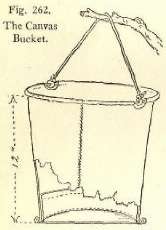
Fig. 262. The Canvas Bucket.

Fig. 263. Mr. Halliday's Water Wheel.
Continue to:


My Books

