


Tailless Kites
Description
This section is from the book "The Scientific American Boy", by A. Russell Bond. Also available from Amazon: The Scientific American Boy.
Tailless Kites
"There's a better place over on the other side of the hill," he said, and led the way to his favorite coasting spot.
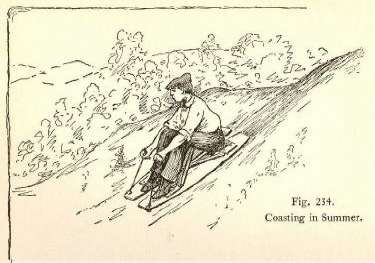
Fig. 234. Coasting in Summer.
But here our attention was diverted from coasting by the curious sight of a full-grown man flying a kite. We found out afterward that he was a Professor Keeler, who had made a great scientific study of kites. Professor Keeler was very affable, and we soon got acquainted with him. His kite was way up in the air, almost out of sight, and was pulling like everything. Neither Bill nor I could hold it long. But the most remarkable part of it all to me was the fact that the kite had no tail. I had heard of tailless kites made like a box, but this one appeared to be very much like the kites I had made in my younger days, and I well knew the importance of a long tail to keep such a kite steady. We asked the professor about it, and were informed that this kite was of the Malay type, which is so designed that the cloth bellies out into pockets on each side of the central stick or backbone, and these pockets balance the kite while the backbone acts as a rudder.
Finding that we were interested in the subject he gave us full instructions for making kites from 5 to 8 feet long, and these I jotted down for future use. In a 5-foot kite he said the stick should be 3/8 inch thick and 1/2 inch wide, in a 6-foot kite 7/16 inch thick and 9/16 inch wide, in a 7-foot kite 5/8 inch thick and 3/4 inch wide, and in an 8-foot kite 3/4 inch thick and 1 inch wide. On the following summer we built a 5-footer and also an 8-footer.
Continue to:


My Books

