


The Double Swedish Sail
Description
This section is from the book "The Scientific American Boy", by A. Russell Bond. Also available from Amazon: The Scientific American Boy.
The Double Swedish Sail
Bill evolved some new types of sails which differed materially from the type described in the first chapter. One was a double sail--"the kind they use in Sweden," he explained. One of the sheets which the foraging party brought in was extra large; it measured approximately two yards and a half square. This was folded on itself, making a parallelogram seven feet six inches long and three feet nine inches wide. The sheets we had were all rather worn and some were badly torn, so that we had to make our sails of double thickness, sewing patches over the weak spots. A broad hem was turned down at each end, and heavy tape was sewed on, leaving loops as before, to attach them to the spars. This reduced the length of our sail to seven feet three inches. The end spars were spaced apart by a light pole about ten feet long, to which they were tied at the points of intersection. The spars were also braced by halyards looped over the ends of the pole in the manner indicated in the drawing (Fig. 7). It took a crew of two boys to manipulate this sail. In use, the pole of the rig was carried on the shoulders, and the sail was guided by means of ropes attached to the lower corners of the vertical spars.
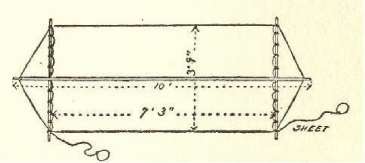
Fig. 6.
Dimensions of Double Swedish Sail.
N. B.--The mark (') means feet and (") means inches.
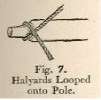
Fig. 7. Halyards Looped onto Pole.
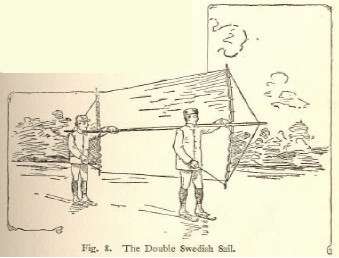
Fig. 8. The Double Swedish Sail.

Fig. 9 Changing Tack.
These ropes in nautic al language are called "sheets." The boy at the rear was the pilot and did the steering, because his position behind the sail gave him an unobstructed view in all directions. When changing tack the sail was lifted overhead to the other side of the crew.
Continue to:


My Books

