


The Lanteen Sail
Description
This section is from the book "The Scientific American Boy", by A. Russell Bond. Also available from Amazon: The Scientific American Boy.
The Lanteen Sail
The lanteen sail we found to be a very good rig. It was made in the form of a triangle, measuring eight feet on one side, seven and one-half feet on another side and six and one-half feet on the third. The six and one-half foot side was secured to a boom, and the seven and one-half foot side to a yard. The yard and boom were hinged together by a leather strap nailed on as shown in Fig. 12, and to this hinge a rope was attached, which served as a sheet. These spars were secured to a mast erected perpendicularly to the boom and intersecting the yard a little above its center. We had had some trouble with the first sails we made in keeping the base of the sail against the body, and to overcome this difficulty Bill proposed tying the bottom of the mast to the leg. This was a rather risky thing to do, as we learned later, for in case of accident it would be difficult to get clear of the sail. It was Reddy who finally solved the problem by rigging up a step for the mast. It consisted of a leather tag tied to the leg, and provided with a hole into which the bottom of the mast was fitted. To prevent the mast from slipping too far into the step the lower portion of it was whittled down, leaving a shoulder which rested on the leather. Bill later devised another step, which consisted of a wooden block (Fig. 14) strapped to the leg and formed with a shallow socket to receive the end of the mast.

Fig. 11. The Lanteen Sail.
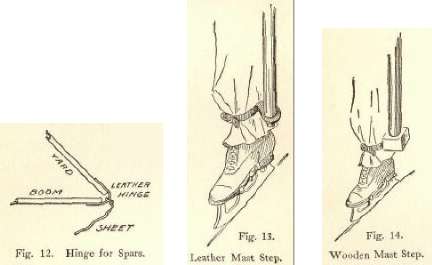
Fig. 12. Hinge for Spars. | Fig. 13. Leather Mast Step. | Fig. 14. Wooden Mast Step.
Continue to:


My Books

