


The Sailing Canoe
Description
This section is from the book "The Scientific American Boy", by A. Russell Bond. Also available from Amazon: The Scientific American Boy.
The Sailing Canoe
Immediately after Mr. Schreiner's departure we started work on the canoe. A strip of spruce 1 inch thick, 3 inches wide and 12 feet long served as the keelson. At the stern a post 1-1/2 inches thick, 3 inches wide and 13 inches high was secured to the keelson with brass screws. This was braced as indicated in Fig. 104. At the bow a stem piece was attached to the keelson. This stem was cut to a somewhat semicircular form, as shown in Fig. 105. The outer edge was tapered with a draw-knife to a thickness of 1/4 inch and a brace was nailed to the inner edge. Our next work was to cut out three forms, one of the shape shown in Fig. 106 and two like that shown in Fig. 107. The first form was set up on the

Fig. 104. Stern Post of the Canoe.
keelson midway between the stem and stern, and the other two were spaced about four feet each side of the center form. The center form was used only for shaping the frame of the boat, and was not intended to be permanently affixed to the canoe. Therefore, we fastened it to the keelson very lightly, so that it could be readily removed. The other
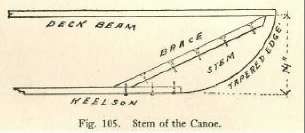
Fig. 105. Stem of the Canoe.
two forms, however, were made permanent parts of the frame, serving as bulkheads. The gunwales were now secured in position. These were of spruce 3/4 inch thick and 2 inches wide. The ends were beveled off so as to neatly fit the stem piece and the stern post, to which they were fastened by brass screws. Then we applied the longitudinal strips, or rib bands, which were of 1/4-inch thick spruce 1 inch wide. Ten of these bands were used, equally spaced apart on the center form, to which they were lightly tacked; but they were nailed securely to the bulkheads and the stem piece and stern post. The cross ribs were made of barrel hoops which we had soaked in water for a day or so to render them pliable enough to be bent into place. These hoops were split to a width of 1/2 inch, and secured first to the keelson, then to the longitudinal strips and finally to the gunwales. Copper tacks were used for nailing the ribs in place, and these were long enough to be passed through the rib bands and clinched on the outside. Forty cross ribs were nailed on, and at the center of the canoe they were spaced about three inches apart. The center form was then removed and cut along the dotted lines shown in Fig. 106. The semicircular pieces thus obtained were now strengthened with strips on their inner edges, and wedged in between the keelson and the gunwales, to which they were nailed, as shown in Fig. 108. A pair of cleats nailed to the cross ribs served as supports for the seat of the canoe. The frame of the boat was completed by nailing in place two deck beams of 1/2-inch square pine and four corner pieces between the gunwales and the bulkheads, so as to make an elliptical well hole or deck opening. Before laying on the canvas covering the edges of the gunwales, keelson, deck beams, stem and stern posts were smoothed down with sandpaper.
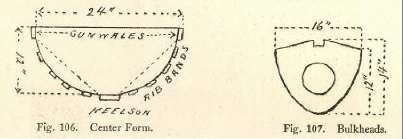
Fig. 106. Center Form.
Fig. 107. Bulkheads.
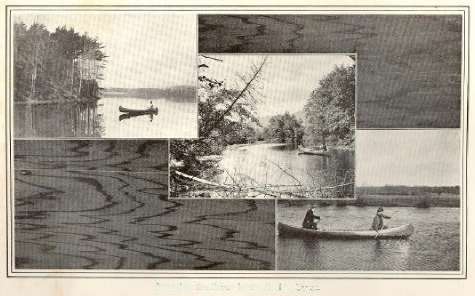
Exploring the River in the Indian Canoe.

Fig. 108. Center Braces.

Fig 109. Top View of the Canoe Frame.

Fig 110. Side View of the Canoe Frame.
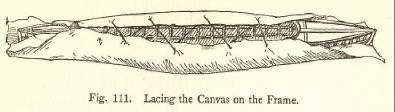
Fig. 111. Lacing the Canvas on the Frame.
Continue to:


My Books

