


The Single Mirror Instrument
Description
This section is from the book "The Scientific American Boy", by A. Russell Bond. Also available from Amazon: The Scientific American Boy.
The Single Mirror Instrument
The first thing we did was to procure a small mirror about 4 inches square, mounted in a wooden frame. Then we got a pair of small square head bolts about 1/4 of an inch in diameter and 1 inch long, also two strips of brass 1/2 inch wide and 3 inches long. In the center of each brass strip we drilled a hole just large enough to admit the shank of one of the bolts, and then the strips were fastened with screws tight against opposite edges of the mirror frame, with the heads pressed against the frame and the shanks sticking out at each side, as shown in Fig. 153. These projecting shanks served as "trunnions" (that is, pivots) for the mirror to turn on when it was mounted in place. After the trunnions had been set in place we made a peep hole in the center of the mirror by cutting out a piece of the wooden back of the frame and scratching away the silver from the back of the glass. Only a very small hole was required, about 1/8 inch in diameter. Great care was taken to have the unsilvered spot exactly on a line with the trunnions and just half-way between them. This done, we took two sticks of 3/8 inch wood, 1 inch wide and 3-1/2 inches long. In the upper end of each stick a slot was cut 1/2 inch deep and 1/4 inch wide. Into these slots the trunnions of the mirror were placed, and then the nuts were screwed tightly on, clamping the sticks against the sides of the mirror. The sticks were now connected by nailing a 1/2-inch strip at the bottom, and braced by a couple of corner pieces. This formed a swiveled frame for the mirror, which was clamped to the base of the instrument by means of a bolt 1-1/2 inches long. The bolt passed through the bottom board of the frame, squarely under the peep hole of the mirror and through the baseboard of the instrument near one end. The baseboard was 2 inches wide, 10 inches long and 3/4 inch thick.
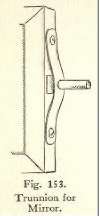
Fig. 153. Trunnion for Mirror.

Fig. 154. The Single Mirror Instrument.
Continue to:


My Books

