


Towers For The Water Wheel
Description
This section is from the book "The Scientific American Boy", by A. Russell Bond. Also available from Amazon: The Scientific American Boy.
Towers For The Water Wheel
First we built the towers to support the wheel. One tower was 16 feet high and the other only 10 feet. The large tower was made something like a very tall and narrow saw-horse. Two stout poles 17 feet long were flattened at their upper ends and nailed together, with the ends projecting about a foot, as shown in Fig. 251. At the bottom these poles were spaced 8 feet apart by a cross bar, and about 9-1/2 feet from the bottom a pair of boards were nailed to opposite sides of the pole to serve as supports for the axle of the water wheel. Another pair of 17-foot poles was now similarly fastened together and then the two pairs were spaced about 12 feet apart and connected at the top and bottom with boards.
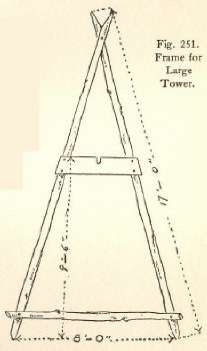
Fig. 251. Frame for Large Tower.
At the top two smooth boards were used and these were nailed to the inner sides of the projecting ends, which were tapered off. In this manner a V-shaped trough was formed. The boards were firmly nailed together at their meeting edges so as to prevent them from warping apart. A diagonal brace at each corner made the wedge-shaped tower very substantial. A number of cleats nailed to one of the poles provided a ladder by which we could mount to the top of the tower. The shorter tower was a three-legged affair, made of three 12-foot poles. At first two of these were flattened and nailed together at their upper ends, and they were braced at the top and bottom. The third leg was then nailed in place and braced by cross bars connecting it with the other two poles.

Fig. 252. The Large Tower. Fig. 253. V Shaped Trough.
Continue to:


My Books

