


Tramp-Proof Boat Mooring
Description
This section is from the book "The Scientific American Boy", by A. Russell Bond. Also available from Amazon: The Scientific American Boy.
Tramp-Proof Boat Mooring
Around the camp fire that night we discussed our adventures and made plans to prevent their recurrence. It was evident, for one thing, that we would have to moor our boats off shore in such a way that they would be out of reach of meddlesome persons, and yet could be drawn in toward shore by anyone who knew how. This was the way we did it. A pair of galvanized iron ring bolts were procured on Jack's next trip to Lamington for provisions, also a light rope about forty feet long. The ring bolts were screwed into a pair of stout anchor stakes about two feet from their, lower ends. The rope was passed through the rings and the ends were joined by tying them to a galvanized iron link. Then it was soaked for a while to shrink it before it was set in place. After the rope had shrunk sufficiently, the two stakes were driven into the bed of the river, one close to the bank and the other far enough out to hold the rope belt clear of the bottom. Both stakes were sawed off under water, just above the ring bolts, so that they were hidden from sight. When we wanted to moor our boats we secured their anchor ropes or "painters" to the link. A large stepping stone marked the spot were the inner stake was driven, and standing on this stone we were able to reach down and haul in on the lower strap of the belt to draw the boat out a safe distance from shore, and then when we wanted to use our boat again we would haul in the upper strap to draw the boat in toward shore.
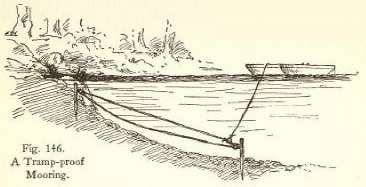
Fig 146. A Tramp Proof Mooring.
Continue to:


My Books

