


Wigwag Signals
Description
This section is from the book "The Scientific American Boy", by A. Russell Bond. Also available from Amazon: The Scientific American Boy.
Wigwag Signals
There were only three different movements that could be made with flags, but in the book different combinations of these movements were given to represent each letter of the alphabet and the numbers from 1 to 0. All these movements were begun and ended by holding the flagstaff upright, directly in front of the body, as shown in Fig. 147. The first movement was to swing the flag down to the right and back (Fig. 148), the second to the left and back (Fig. 149), and the third forward and back (Fig. 150).

Fig. 147. Fig. 148. Fig. 149. Fig. 150
Ready. First Movement. Second Movement. Third Movement.
The following table gives the different combinations used for various letters:
A................22
B ............2112
C ..............121
D ..............222
E ................12
F.............2221
G............2211
H..............122
I ...................1
1.................1111
2.................2222
3.................1112
The Wigwag Alphabet.
J ............... 1122
K ............. 2121
L ................ 221
M ............. 1221
N ................. 11
O ................. 21
P .............. 1212
Q ............. 1211
R ................ 211
Numerals.
4 ................. 2221
5 ................. 1122
6 ................. 2211
7 ................. 1222
V .............1222
W ............1121
X.............2122
Z .............2222 tion..........1112
8.....................2111
9 ....................1221
0....................2112
The numbers 1, 2 and 3 indicate respectively the first, second and third movements. For instance, A was represented by the combination 22, which means that the flag must be swept to the left and back twice. B is represented by the combination 2112, that is, a sweep to the left, two sweeps to the right and a final sweep to the left, as shown in Fig. 151. The end of a word was represented by a sweep forward and back: the end of a sentence by two sweeps forward and back, and the end of a message by three sweeps forward and back. It will be noticed that the same combinations are used for 2 and Z, 3 and tion, 4 and F, 5 and J, 6 and G, 7 and V, 9 and M, and 0 and B. The following abbreviations were given in the Manual:
Abbreviations:
a ................ after
n .................. not
uc .................. your
b ................ before
r ................... are
w ................. word
c ................ can
t ................... the
wi ................ with
h ................ have
u .................. you
y .................. yes
These abbreviations saved a lot of time, for when we wanted to signal the word after instead of spelling it out--22-2221-2-12-211-3--we used the signal for A--22--followed by 3 to signify that it was the end of the word. Before was represented by 2112-3, your by 111-211-3, etc. It took quite a little practice to learn the different combinations. Fred and Reddy soon became experts, and could flash the signals back and forth at a great rate.
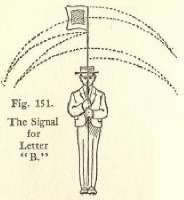
Fig. 151. The Signal for Letter "B."
Continue to:


My Books

