


Drainage Of Lands By Pipes
Description
This section is from the book "The English And American Mechanic", by B. Frank Van Cleve. Also available from Amazon: The English And American Mechanic.
Drainage Of Lands By Pipes
Soils. | Depth of Pipes. | Distance apart. | |
Ft. | In. | Feet. | |
Coarse gravel sand. | 4 | 6 | 60 |
Light sand with gravel | 4 | 50 | |
Light loam................. | 3 | 6 | 33 |
Loam with clay...... | 8 | 2 | 21 |
Soils. | Depth Of Pipe*. | Distance apart. | |
Ft. | In. | Feet. | |
Loam with gravel... | 3 | 27 | |
Sandy loam......... | 3 | 9 | 40 |
Soft clay......... | ? | 9 | 21 |
Stiff clay | 2 | 6 | 15 |
Sewers. Circular
55 √z X 2f = v, and v X a = V; x representing area of sewer / the wetted perimeter, f inclination of do. per mile, and v velocity of flow, in feet per minute; a area of flow in square feet, and V volume of discharge in cubic feet per minute.
Egg
D /3 = w, 2D/3 = w', and D = r. D representing height of sewer, w and w' width at bottom and top, and r radius of sides.
In culverts less than 6 feet in depth,* the brick-work should be 9 inches thick. When they are above 6 feet and less than 9 feet, it should be 14 inches thick.
If the diameter of top arch = 1, the diameter of inverted arch = .5, and the total depth = the sum of the two diameters, or 1.5, then the radius of the arcs which are tangential to the top, and inverted, will be 1.5.
From this any two of the elements can be deduced, one being known.
Oval
Top and bottom* should be of equal diameters. The diameter .76 depth of culvert; the intersections of the top and bottom circles form the centres for striking the courses connecting the top and bottom circles.
The inclination of sewers should not be less than 1 foot in 240.
Fig. 42.
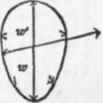
Dimensions, Areas, And Volume Of Work Per Lineal Foot Of Egg-Shaped Sewers Of Different Dimensions
Intersil Dimension!. | Volume of Brick-work. | |||||
Depth. | Diameter of Top Area. | Diameter of Invert. | Area. | 4½ Inch Thick. | 9 Inch Thick. | 13½ Inch Thick. |
Feet. | Feet. | Feet. | Sq. Feet. | Cub. Feet. | Cab. Feat. | Cub. Feet. |
2. ¼ | 1.5 | .75 | 2 63 | 2.81 | ............... | ............... |
3. | 2. | 1-. | 4.5 | 3.56 | ............... | ............... |
II | 2.5 | 1.25 | 7.03 | 4.31 | 9.56 | ............... |
4.½ | 3. | 1.5 | 1012 | 5.06 | 1087 | ............... |
5.½ | 3.5 | 1.75 | 13.78 | 5.81 | 12.75 | ............... |
6. | 4. | 2. | 18. | 6.56 | 14.25 | ............... |
6.¾ | 4.5 | 2.25 | 22.78 | 7.31 | 15.75 | 24.75 |
7.½ | 5. | 2.5 | 28 12 | ............... | 17.06 | 27. |
8.¼ | 5.5 | 2.75 | 34.03 | ............... | 18. | 28.41 |
9. | 6. | 3. | 40.5 | ............... | 19.69 | 30.94 |
In laying large sewers through quicksands, cast-iron inverts are sometimes employed, and with success, to connect the foundation of the whole work together.
* Internal dimensions.
Area of Surface from which Circular Sewers will discharge Water equal in Volume to One Inch in Depth upon surface per Hour, including ordinary City Drainage.
Inclination in Feet | Diameter of Sewers in Feet. | |||||
2 | 2½ | 8 | 4 | 5 | 6 | |
Area. | Area. | Area. | Area. | Area. | Area. | |
None......... | 38¾ | 67¼ | 120 | 277 | 570 | 1020 |
1 in 480...... | 48 | 75 | 135 | 308 | 630 | 1117 |
1 in 240...... | 50 | 87 | 155 | 355 | 735 | 1318 |
1 in 160...... | 63 | 118 | 808 | 460 | 950 | 1692 |
1 in 120...... | 78 | 143 | 257 | 590 | 1200 | 2180 |
1 in 80....... | 90 | 165 | 295 | 670 | 1388 | 2486 |
1 in 60....... | 125 | 182 | 318 | 730 | 1500 | 2675 |
Continue to:


My Books

