


How To Describe A Carved Elbow
Description
This section is from the book "The English And American Mechanic", by B. Frank Van Cleve. Also available from Amazon: The English And American Mechanic.
How To Describe A Carved Elbow
Fig. 7.
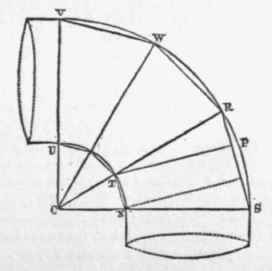
Fig. 8.
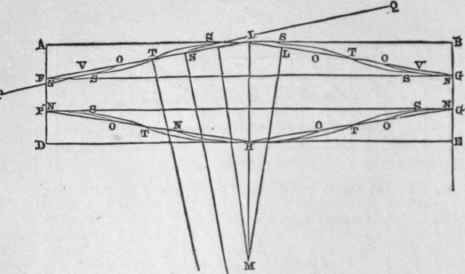
Describe two circles U X and V'S, the curves desired for the elbow, having the distance from U to V' equal to the diameter; then divide the circle V, W, R and S, into as many sections as desired; then construct a rectangle, Fig. 8, A D E B, the width equal to the width of one section V'W, Fig. 7, and the length equal to the circumference of the elbow: then span the dividers from the point R to the point P at the dotted line, Fig. 7, and with the dividers thus spanned mark the points F F' Fig. 8, from points A and D, and draw the lines F G and F'G'; frqm point I draw the two diagonal lines I F and I G, span the dividers so as to divide one of these diagonal lines into six equal parts, viz., I, L, 0, T, 0, V, G; from the point L erect a perpendicular line produced until it intersects the line I H produced ; from the point of intersection M, as a centre, describe the arc N I O for the top of the elbow; with the same sweep of the dividers describe the arcs N 0 and N O; then draw an indefinite straight line P Q tangent to the arcs N 0 and N I, having the points of contact at S and S; on this tangent line erect a perpendicular line passing through the point N (same as in Fig. 6), produced until it intersects the line B E produced; then place one foot of the dividers on the point of intersection and span them over the dotted line to the point T, (same as in Fig. 6), and with the dividers spanned describe the arcs T S, T S, T S, and T S; these arcs and the arcs N 0, N I O and 0 N, will be one side of the section, and by the same rule the other side of the section may be described at the same time, which will be a pattern to cut the other sections by.
Continue to:


My Books

