


Problem IX. How To Draw An Ellipse By Means Of Two Concentric Circles
Description
This section is from the book "The English And American Mechanic", by B. Frank Van Cleve. Also available from Amazon: The English And American Mechanic.
Problem IX. How To Draw An Ellipse By Means Of Two Concentric Circles
Fig. 37.
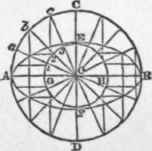
Let a b be the transverse, and E F the conjugate diameter, and 0 the centre of an ellipse to be drawn. From O with the radius O a, describe the circle a c b d, and from the same centre describe another circle G e H f. Divide the outer circle into any number of equal parts; the greater the number, the more exact will be the ellipse: and they should not be less than twelve. From each of these divisions draw lines to the centre o, as a o, b o, c o. Then, from a, b, c, etc., draw lines perpendicular to a b, and from the corresponding points in the inner circle, that is, from the points marked 1, 2, 3, etc., draw lines parallel to a B. Draw a curve through the points where these lines intersect each other, and it will be an ellipse.
In the diagram to which this demonstration refers, only one quarter of the ellipse is lettered, but the process described in relation to that must be carried round the circles, as is shown in the dotted and other lines.
Continue to:


My Books

