


Proportion Of Circles
Description
This section is from the book "The English And American Mechanic", by B. Frank Van Cleve. Also available from Amazon: The English And American Mechanic.
Proportion Of Circles
Fig. 2.
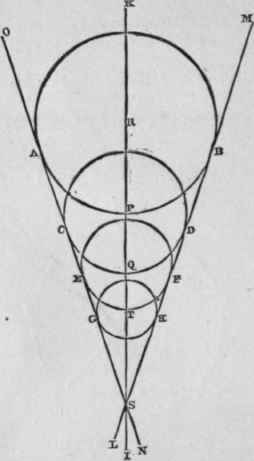
To enable machinists to enlarge or reduce machinery wheels without changing their respective motion.
First, describe two circles A B and C D the size of the largest wheels which you wish to change to a large or small machine, with the centre P of the smaller circle C D on the circumference of the large one A B; then draw two lines L M and N 0 tangent to the circles A B and C D, and a line I K passing through their centres P and R; then if you wish to reduce the machine, describe a circle the size you wish to reduce it to; if one-half, for example, have the centre Q one-half the distance from R to S and describe the circle E F, and on its circumference T as a centre, describe a circle G H, allowing their circumferences to touch the tangent lines L M and N O, which will make the circle E F one-half the sire of the circle A B, and G H one-half the size of C D; therefore E F and G H are in the same proportion to each other as A B and CD.
If you wish to reduce one-third, have the centre Q one-third the distance from R to S; if one-fourth, have the centre Q one-fourth the distance from R to S, and so on. This calculation may be applied beyond the centre R for enlarging machine wheels, which will enable you to make the alteration without changing their respective motion.
Continue to:


My Books

