


Applying Bromide Solution To Paper
Description
This section is from the book "Cassell's Cyclopaedia Of Mechanics", by Paul N. Hasluck. Also available from Amazon: Cassell's Cyclopaedia Of Mechanics.
Applying Bromide Solution To Paper
The method of applying the bromide solution suggested by Captain Abney is an excellent one, and consists of spraying it with a sort of wash bottle made as follows. Fit a cork to a 1-in. bore test tube or a small wide-mouth bottle. Take a length of glass tubing, and separate it into two portions about Sin. longer than the extreme depth of the bottle by gently heating in a spirit or gas flame, keeping it revolving all the lime until the glass softens, when it may be pulled steadily apart as shown in Fig. 1. If the tube is wetted or breathed on, it may crack. Warm again in the same manner, and bend to the shape shown in Fig. 2. Cut away the closed portion from the other piece by scratching with a tile and snapping off. Then bend as shown in Fig. 3, melt the end A to soften off the edges, and, whilst soft, squeeze flatter with the pliers, pressing very gently. Now bore two holes straight and parallel through the cork, a little smaller than the tubing; a rat-tail file can be used if a borer is not available. Insert the tubes in the cork, and the cork in the test tube. Strip off the extreme end or tip B, which will give a tiny hole. It will then present the appearance shown in Fig. 4. The part A should be put in the lips, and a gentle current of air forced through, when a fine spray will result. For coating the paper a trough will be necessary; or a dish may be used, set at an angle as shown in Fig. 5, and supported by a block C. On a glass rod or a length of glass tubing, roll some lengths of chemically pure paper to about 1/2 in. thick, and glue down. This will make a roller about 1 1/4in. thick, the thick part to be shorter than the dish. Now wind upon it as tightly as possible, coated side outwards, some Rives or Saxe paper of suitable width, and fasten with a rubber band at the extreme edges. Construct a tank of metal (see X.Fig. 5), the pattern of which is shown in Fig. 6, and bend on the dotted lines and solder together. The two ends of the tubing are now placed through the cuts Z Z, bringing the paper well below the sides of the dish. Now fill the lower tank with boiling water, and pour the melted emulsion into the porcelain dish, which should be free from cracks. Unwind the paper slowly, passing it through the emulsion. Withdrawing the paper rapidly gives a thicker coating. The paper as coated should be drawn over laths placed above the tank, and allowed to dry spontaneously in a well-ventilated room free from dust.
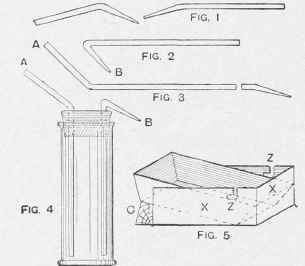

Apparatus for Applying Bromide Solution to Paper.
Continue to:


My Books

