


Distinguishing Woods
Description
This section is from the book "Cassell's Cyclopaedia Of Mechanics", by Paul N. Hasluck. Also available from Amazon: Cassell's Cyclopaedia Of Mechanics.
Distinguishing Woods
To distinguish between spruce (or whitewood) and yellow deal (or Baltic redwood), the difference in colour should be noted. In the redwood, the lines that constitute the figure are a light tabac colour, or golden brown. If the wood is extra resinous, the lines are trauslucent. The intervening parts of the layers are cream. In spruce the " red " lines are much less distinct, though nearly similar in colour. But the colour is paler, and the lines are never translucent. The intervening layers are quite white, giving the wood an altogether whiter appearance than in the redwood. If the planks are weathered and discoloured, notice the knots. By reason of a difference in the branching habit of the two trees that furnish these woods, a great variation is noticeable in the dispositions of the knots as they appear in the planks. In the whitewood tree (the spruce fir) the branches are small, and strike out from the trunk approximately at right angles. This causes the knots in whitewood to appear as perfectly circular areas or else of an elliptical shape, the long way or major axis of the ellipse being at right angles to the grain of the wood (see a, b, C, Fig. 1). When freshly planed, the knots are a pink fawn in colour. They are irregularly distributed through the wood. In the redwood tree (the Scotch fir), the branches shoot upwards more, and the knots are consequently inclined in the wood. Figs. 1 and 2 show the comparative difference. They are, besides, more regularly disposed, and are mostly found in groups together, at distances of lit. to 2ft. apart, as shown at D, E, F (Fig. 2). This feature is prominent in the poorer grades of this wood. The knots are amber or deep brown. Archangel white-wood is obtained from the same kind of tree as Baltic whitewood. There a,re therefore no structural or other differences between these two, except that of quality (and size), due to better selection, soil influences, and, perhaps, climatic conditions. The only guide in this case is an acquaintance with the market forms, shipping marks, and brands, etc., that apply to each. Yellow pine is an American wood, usually handled in larger and shorter planks than each of the preceding. The wood is a light straw colour, and much finer in the grain than either white or yellow deal. The "red" line in this wood is scarcely perceptible. The knots are few but large, and often loose and black. An expert will distinguish these woods by their odour j sometimes the grain of a piece is so false that there is (except under the microscope) no other ready means of identifying it. Help will be afforded by noting the difference in weight.
White deal weighs about 301b. a cubic foot, yellow deal about 33 lb., and yellow pine about 28lb.
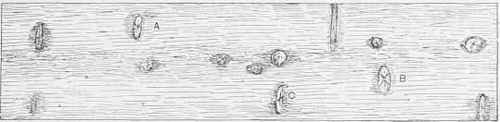
Fig. I.
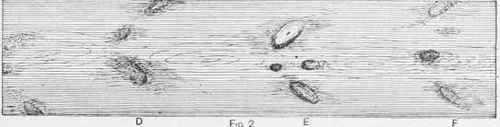
Distinguishing Woods.
Continue to:


My Books

