


Filter Beds For Municipal Water Supply
Description
This section is from the book "Cassell's Cyclopaedia Of Mechanics", by Paul N. Hasluck. Also available from Amazon: Cassell's Cyclopaedia Of Mechanics.
Filter Beds For Municipal Water Supply
There is no mere satisfactory method of filtering what is already practically pure water than by constructing two or mo'e filters of sand and using them for alternate periods. Each filter (if two be the number) should be large enough to do all the work whilst the other is resting or being cleansed. The rate at which sand filters can be best worked is 511 gal. per square yard per day. The accompanying illustrations show two filters each 9 yd. by i yd., which would be able to deal with 18,000 gal. of water every twenty-four hours. The water flows in at A. or A', passes downwards through the filter, and finds its way into the main pipe by the outlet B or B'. An escape pipe is provided at C and C. To cleanse a filter by upward flow the valve V is closed (say filter No. 2 is to be cleansed), the escape at "C is opened, the water is made to enter niter No. 1 at A (Fig. 1), it passes out through B, cannot flow through the valve V, so rises through B', thence through the sand, and out by C This flow is allowed to continue for half an hour, or as long as may be found necessary for cleansing the filter; when the water passing through C is clear, the valve V is opened, and C is closed. Fig. 2 shows a longitudinal section through the filter. Fig. 3 shows the thicknesses of the layers of sand and gravel in the filter. When there are only two filters, the town supply has to be interrupted during this process of washing; with three or more filters, the pipes can be so arranged that no interruption takes place.
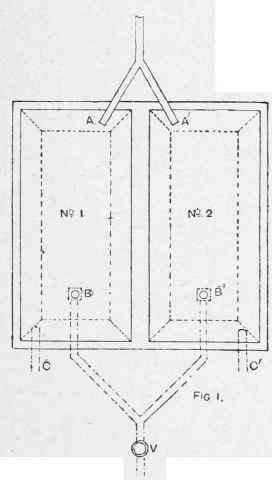
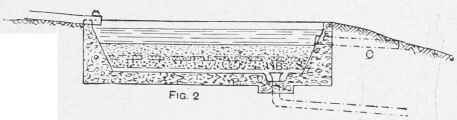
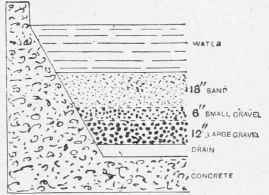
Fig. 3. Filter Beds for Municipal Water Supply.
Continue to:


My Books

